
What Aston Martin Maintenance Actually Costs You Each Year
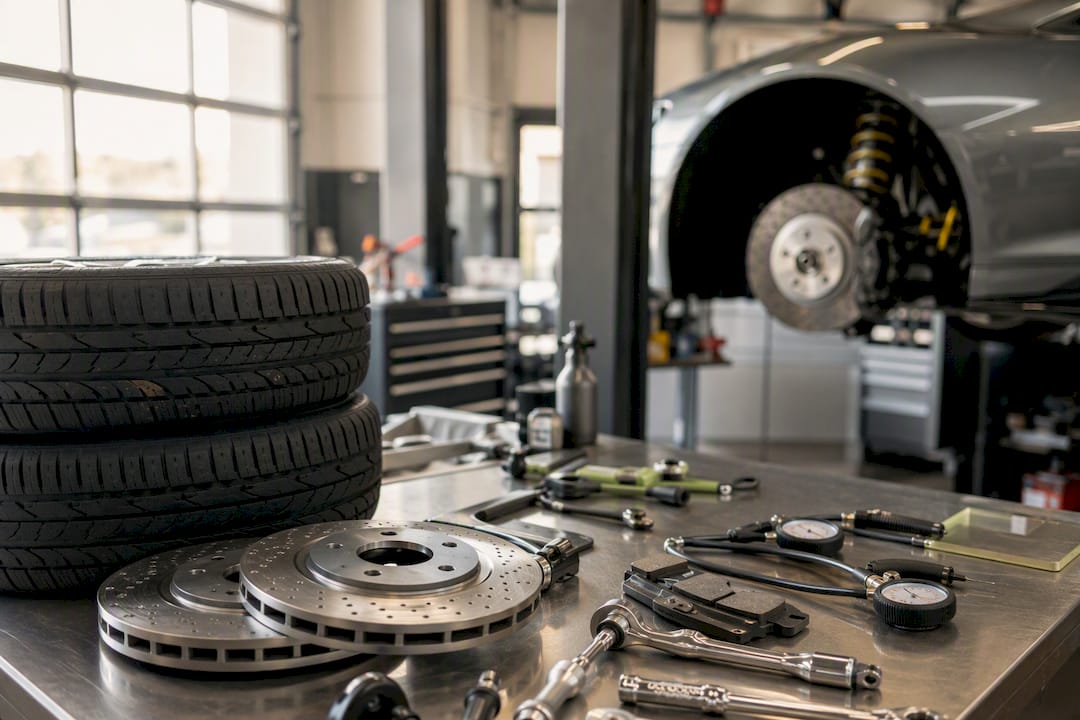
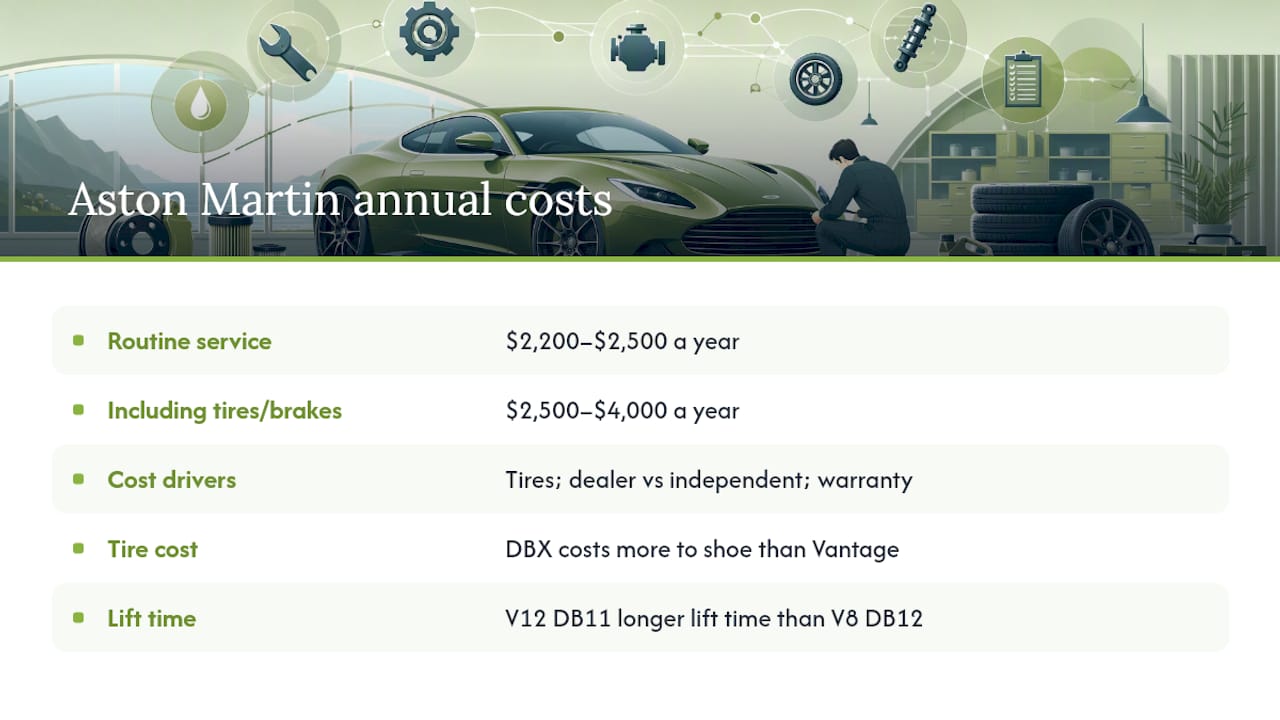
Budget $2,200 to $2,500 a year for routine Aston Martin maintenance, and $2,500 to $4,000 once you factor in tires and brakes on a normal ownership cycle, according to ConsumerAffairs. Three things swing that number hardest: tire and brake replacement cycles, whether you use a dealer or an independent specialist, and whether you’re still covered by factory warranty. A DBX with SUV-sized tires costs more to shoe than a Vantage, and a V12 DB11 takes longer on the lift than a V8 DB12, which shows up directly in your labor bill.
Key Takeaways
Aston Martin ownership costs run $2,500 to $4,000 annually once tires and brakes are factored in, with model, warranty status, and dealer-versus-independent choices driving most of the variance.
| Point | Details |
|---|---|
| Budget realistically | Plan for $2,200 to $2,500 in routine costs, and $2,500 to $4,000 including tire and brake cycles. |
| Watch for spike years | Tires and brakes cause the biggest single-year jumps. |
| Model changes the math | DBX’s larger tires and V12 engines in cars like the DB11 raise parts and labor costs versus a Vantage or V8 DB12. |
| Balance dealer vs independent | Independent specialists can cut labor 30 to 40 percent, but dealer history protects resale and CPO eligibility. |
| Source parts smart | Supercars.parts helps you compare OEM and aftermarket pricing across DB11, Vantage, DBX, and DB12 before you buy. |
Where to Go for More on Aston Martin Ownership Costs
- ConsumerAffairs for aggregated dealer pricing and warranty guidance.
- Aston Martin’s official servicing schedule for mileage-based service intervals.
- AxleAddict and Yahoo ownership reporting for owner-reported cost breakdowns.
- CarEdge for total five-year cost of ownership context.
Use the official schedule for dealer pricing accuracy; use the owner-report sources for realistic, real-world spending patterns.
Table of Contents
- What Drives Aston Martin Maintenance Costs Each Year
- How Often Does Aston Martin Require Scheduled Service?
- What Repairs Cost the Most Once the Warranty Runs Out?
- How Can You Lower Your Aston Martin’s Annual Maintenance Bill?
- Where Should You Source Aston Martin Parts?
- Is an Aston Martin Worth the Maintenance Cost?
- What Owners Actually Say About Living With These Costs
- Find Aston Martin Parts Without the Guesswork
- Frequently Asked Questions
- Sources
What Drives Aston Martin Maintenance Costs Each Year
The routine stuff is predictable, at least on paper. An oil change on most models runs $400 to $600, largely because Aston Martin’s undertray removal and OEM-spec fluids push labor time past what you’d expect on a mainstream car, with dealer service pages reporting typical oil-service windows of 60 to 90 minutes once you add filter and inspection work. Scheduled inspections and fluid top-offs add roughly $1,000 in a typical year, based on line-item estimates from AxleAddict.
Here’s the itemized picture most owners actually see:
- Oil change: a few hundred dollars
- Annual inspection and fluids: around one thousand dollars
- Air and pollen filters: up to several hundred dollars depending on model
- Battery replacement: varies by model, typically a few hundred dollars
- Spark plugs and coils: well over a thousand dollars when due
- Brake pads and rotors: several thousand dollars
- Tires, full set of four: multiple thousand dollars depending on model
A low-mileage year where you’re only doing an oil change, inspection, and filters lands close to that $2,200 to $2,500 baseline. A spike year, where tires or brakes come due, can push total spend to $4,000 or more, a pattern confirmed by both ConsumerAffairs and Yahoo’s ownership reporting.
Pro Tip: Ask your service advisor whether tire and brake replacement can be staggered across two service visits instead of hitting both in the same year. Spreading the spend smooths your annual budget considerably.
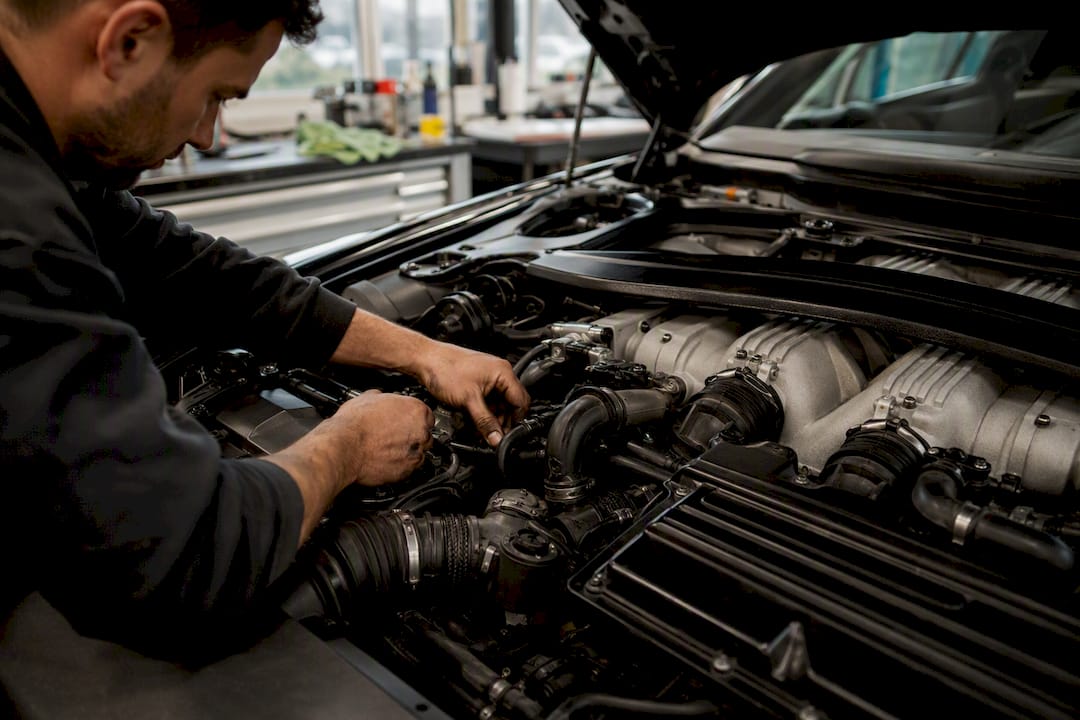
Model matters more than most buyers expect going in. The DBX’s larger tires and SUV-oriented suspension components cost more to replace than the Vantage’s, and the DB12’s updated electronics can mean longer diagnostic time if something in the infotainment or driver-assist suite acts up. V12 engines in cars like the DB11 also take longer to service than the V8 variants, since there’s more engine to access and more spark plugs and coils to check.
How Often Does Aston Martin Require Scheduled Service?
Aston Martin’s factory schedule runs on a mileage ladder: service at 1 year or 10,000 miles, again at 2 years or 20,000 miles, and again at 3 years or 30,000 miles, with specific parts triggered at each stage according to the official Gaydon servicing schedule.
- 1 year / 10,000 miles: oil, filters, general inspection
- 2 years / 20,000 miles: brake fluid change, deeper inspection items
- 3 years / 30,000 miles: air filter, spark plugs on some models, transaxle or differential oil check
Sample published prices from the UK schedule show pollen and air filters running roughly £90 to £380 depending on model, a reminder that global buyers should convert local currency rather than assume US dollar parity.
- Dealer service preserves your documented history for CPO (“Timeless”) eligibility and resale value.
- Independent shops often undercut dealer labor rates substantially.
- The trade-off is real: cheaper now, potentially less valuable paperwork later.
What Repairs Cost the Most Once the Warranty Runs Out?
Out-of-warranty Aston Martin repairs don’t follow one predictable failure pattern, which makes budgeting for them harder than budgeting for tires. Service advisors note a genuine reliability improvement in recent model years, with many early defects now caught under warranty, but failures on older or high-mileage cars are still case-by-case rather than a single recurring issue, per ConsumerAffairs.
The categories worth planning for:
- Electrical gremlins: intermittent sensor or module faults, often diagnosed in the low hundreds but occasionally requiring a $1,000+ module replacement.
- Clutch wear (manual and some automated manuals): typically appears between 30,000 and 60,000 miles, with replacement costing several thousand dollars.
- Suspension bushings and dampers: wear-related, usually surfacing past 40,000 miles.
- Cooling system leaks: hoses and seals degrade with age more than mileage, especially on cars that sit.
- Transmission servicing: scheduled fluid changes are cheap; a failed component is not.
A single major repair on an out-of-warranty car can exceed $6,000, and that number holds whether the fault is electrical, mechanical, or cooling-related.
How Can You Lower Your Aston Martin’s Annual Maintenance Bill?
Independent Aston specialists can cut labor costs by roughly 30 to 40 percent on non-warranty work, which matters most once your car is past its coverage window.
- Use independent specialists for out-of-warranty repairs; keep dealer visits for anything tied to warranty or CPO requirements.
- Buy tires and brake pads through specialist parts channels and stagger replacement cycles rather than doing both in one visit.
- Fit a battery maintainer if the car sits for weeks at a time, and start it periodically even when you’re not driving it.
Pro Tip: A trickle charger costs less than a single tow bill. Cars that sit through winter without one are far more likely to need a battery, and sometimes a starter, by spring.
Where Should You Source Aston Martin Parts?
You’ve got three real channels: the dealer for guaranteed-fit OEM parts at premium prices, an independent specialist for supply-and-fit at lower labor rates, and a dedicated parts marketplace for broader selection across both OEM and aftermarket listings.
- Dealer: highest cost, best fit guarantee, protects service history.
- Independent specialist: lower labor, but verify Aston-specific experience before committing.
- Specialist marketplace: wider selection, competitive pricing, useful for rare or discontinued parts across DB11, Vantage, DBX, and DB12.
An AI-driven marketplace search cuts the time spent hunting for a hard-to-find part, which matters when a car is sitting on a lift waiting on one component.
Is an Aston Martin Worth the Maintenance Cost?
An Aston Martin makes sense for enthusiasts with a second vehicle, low-mileage collectors, and anyone who treats maintenance as part of the hobby, not for someone using it as a single daily driver on a tight budget. Plan for $2,500 to $4,000 a year, plus a reserve for the occasional bigger spike.
What Owners Actually Say About Living With These Costs
Owners describe a consistent trade: real pride behind the wheel, quiet acceptance of the bills, and a habit of shopping around. Many alternate dealer visits with trusted independents and space out tire and brake jobs on purpose to keep any single year from hurting.
Find Aston Martin Parts Without the Guesswork
Supercars.parts gets you to the exact DB11, Vantage, DBX, or DB12 part faster than digging through dealer backorders or cold-calling specialists, since its AI-driven search pulls from over 365,000 listings covering OEM and aftermarket components.
Search by VIN or part number, compare OEM against aftermarket pricing side by side, and check seller ratings before you commit. Whether you’re staggering a brake job to avoid a cost spike or chasing down a discontinued trim piece for an older DB11, start your search at Supercars and see what’s actually available before you call around.
Frequently Asked Questions
What’s a realistic annual Aston Martin maintenance cost? Most owners land between $2,200 and $2,500 for routine care, and $2,500 to $4,000 in a year that includes tires or brakes.
Do DBX, Vantage, DB11, and DB12 cost the same to maintain? No. The DBX’s larger tires and SUV components cost more, V12 models like the DB11 take longer to service than V8 variants, and the DB12’s updated electronics can mean longer diagnostic time.
Does an extended warranty make sense? It depends on your risk tolerance. Extended coverage is often quoted around $5,500 per year of added protection, which only pays off if you’re worried about a major failure exceeding that cost.
Can independent shops really save money without hurting resale value? Yes, for non-warranty work. Keep dealer visits for anything tied to warranty terms or CPO eligibility, and use independents for routine wear items in between.
How much does a major out-of-warranty repair typically cost? A single significant repair, electrical, cooling, or drivetrain related, can exceed $6,000, so build a reserve beyond your routine maintenance budget.


