Ceramic vs Metallic Pads: Which One Fits Your Driving?
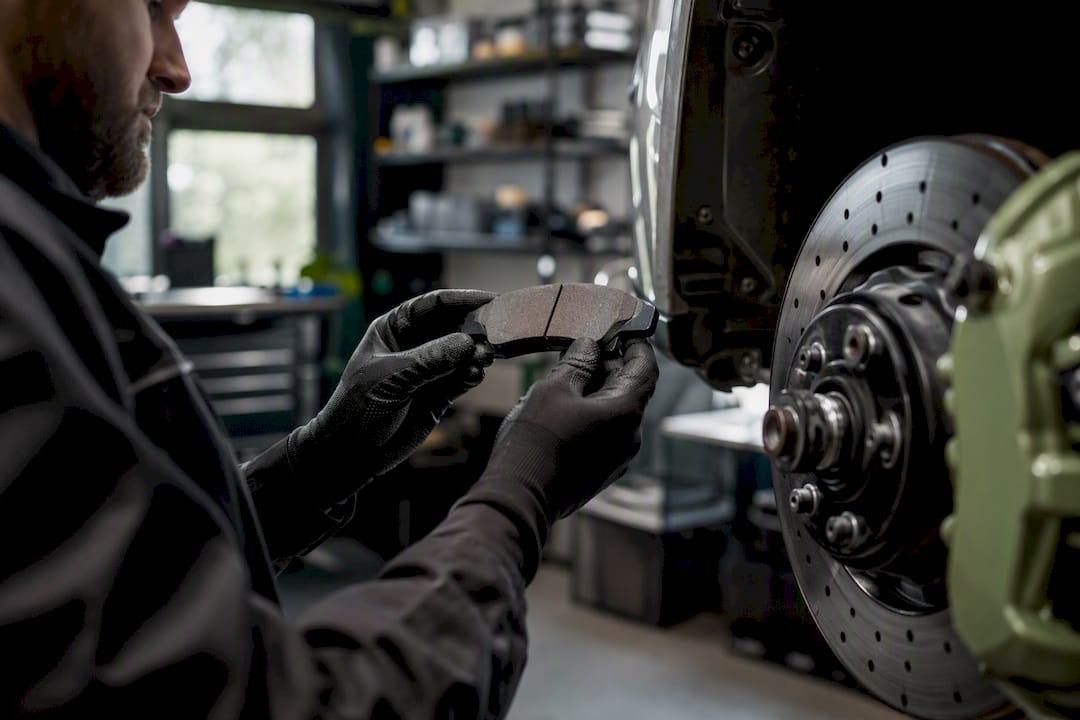
For most daily drivers who want quiet stops, minimal wheel dust, and rotors that last, ceramic pads are the right call. If you tow, drive mountain grades, or spend track days pushing your car hard, semi-metallic pads handle the heat better. The trade-off runs both directions: ceramics stay clean and quiet but transfer more heat into your rotors, while semi-metallics stop harder under stress but wear rotors faster and leave darker dust behind.
TL;DR:
- Ceramic pads are ideal for daily driving due to their quiet operation, light-colored dust, and gentle rotor wear, but they transfer more heat into rotors.
- Semi-metallic pads handle high heat better, offering consistent stopping power during aggressive driving, towing, or track use, but produce darker, heavier dust and faster rotor wear.
- Under high temperatures or repeated heavy braking, semi-metallic pads maintain friction better and reduce fade, making them safer for towing and performance driving.
- Properly matching brake pad material to your driving style and vehicle specifications is essential, with OEM friction standards guiding the best choice.
- Sourcing precise pads for exotic cars requires verifying exact dimensions and friction specs through specialized marketplaces to prevent fitment errors.
Table of Contents
- Ceramic vs Metallic Brake Pads at a Glance
- What Ceramic and Metallic Pads Are Actually Made Of
- How Each Pad Handles Heat and Repeated Braking
- Noise, Dust, and Rotor Wear You’ll Actually Notice
- Comparing Lifespan and Total Cost
- How to Choose the Right Pad for Your Vehicle
- Sourcing the Right Pads for Exotic and Performance Cars
- What Actually Matters Once You Get Past the Marketing
- Where to Find Correct-Fit Pads for Your Exotic
- Sources
Ceramic vs Metallic Brake Pads at a Glance
Before you dig into the mechanics, here’s the practical breakdown that most owners actually need.
- Noise: Ceramic pads run quieter across normal driving conditions; semi-metallic pads tend to squeal more, especially when cold.
- Dust: Ceramic dust is light-colored, fine, and non-corrosive. Semi-metallic dust is darker, heavier, and can stain wheel finishes if it sits too long.
- Rotor wear: Ceramic pads are gentler on rotors over time. Semi-metallic compounds are more abrasive, meaning faster resurfacing intervals.
- Heat tolerance: Semi-metallic pads handle sustained high heat far better, since ceramic compounds tend to droop past roughly 450°C while metallics keep a rising friction curve.
- Best for: Ceramic suits commuting, city driving, and daily luxury car use. Semi-metallic suits towing, track days, and mountain descents.
One more thing worth knowing: EPA guidance now caps copper content in brake pads at 0.5% or less by weight, which has pushed manufacturers on both sides to reformulate their friction materials over the past decade.
If you drive mostly in traffic and care about clean wheels, go ceramic. If you haul a trailer or chase apexes, go semi-metallic.
What Ceramic and Metallic Pads Are Actually Made Of
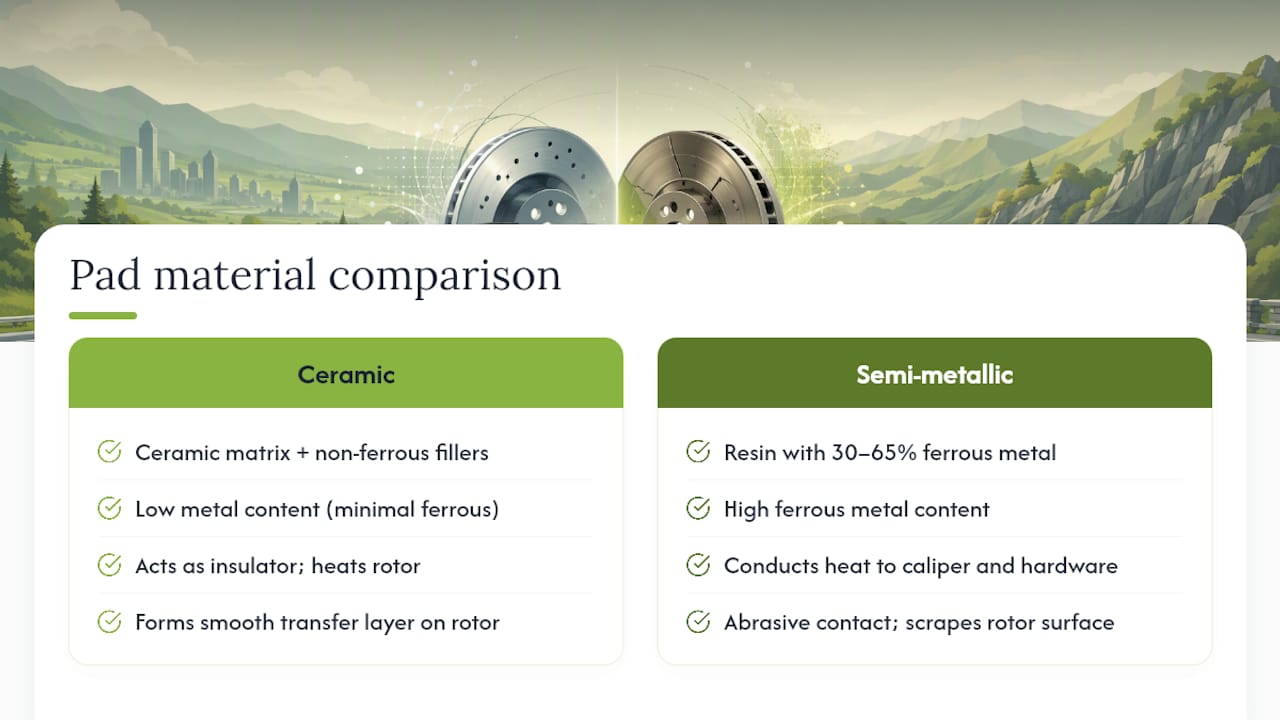
The differences you feel at the pedal start with the raw materials. Ceramic pads use a dense ceramic matrix mixed with non-ferrous fillers like copper substitutes, non-abrasive fibers, and small amounts of metal for strength. That composition makes them chemically stable and quiet, but it also makes them act like an insulator rather than a conductor.
Semi-metallic pads take the opposite approach. They pack in 30 to 65 percent ferrous metal content, usually steel wool, iron powder, or copper alloys bonded into a resin matrix. That metal content is what lets them conduct heat away from the friction surface instead of trapping it there.
The practical result shows up in two ways. Ceramic pads build a smooth, even transfer layer on the rotor surface that produces low noise and predictable bite, but since the pad doesn’t pull heat away efficiently, more of the thermal load gets pushed into the rotor itself. Semi-metallic pads work more abrasively, scraping across the rotor surface, which conducts heat into the caliper and hardware but also grinds down rotor material faster. Neither approach is “wrong.” They’re just built for different jobs.
How Each Pad Handles Heat and Repeated Braking
Cold bite matters more than most people realize. Semi-metallic pads generally need a moment to warm up before they hit full stopping power, while ceramic compounds tend to grip consistently from the first pedal press, which is part of why automakers standardized ceramics on many street-focused luxury vehicles.
The story flips once things heat up. Ceramic pads can lose bite as temperatures climb past their comfort zone, and repeated hard stops, like a long mountain descent in low gear with the brakes doing most of the work, can push them toward fade faster than you’d expect from a “premium” pad. Semi-metallic compounds hold a rising friction curve well beyond that point, staying predictable even as things get hot.
That’s not an abstract spec sheet difference. It’s the reason a truck towing a trailer down a grade, or a car doing back to back track sessions, needs metallic pads that keep working when the discs are glowing. Ceramic pads simply weren’t engineered for that kind of sustained thermal load, and pushing them there is where drivers get surprised by a soft pedal at the worst possible moment.
Noise, Dust, and Rotor Wear You’ll Actually Notice
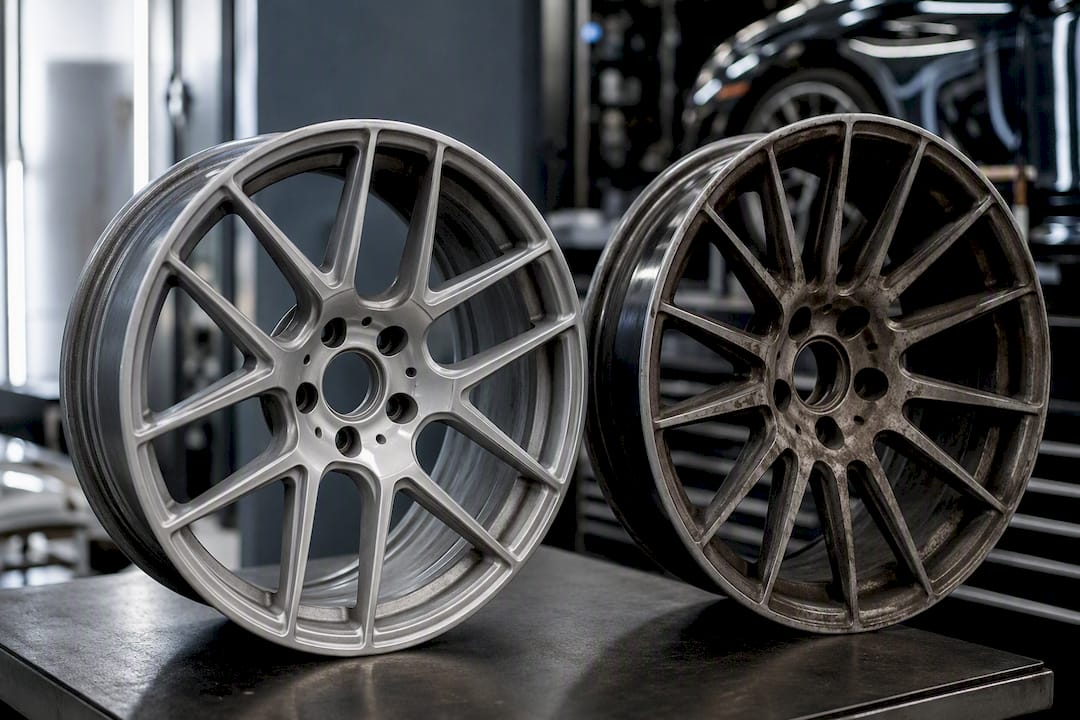
The dust difference is the most visible day-to-day distinction. Ceramic dust is fine, light, and easy to rinse off. Semi-metallic dust is darker, heavier, and iron-rich, and if it sits on a wheel for weeks, it can chemically embed and stain the finish, which matters a lot more on a forged wheel than a steel one.
Rotor wear follows the same pattern. The abrasive action in semi-metallic pads chews through rotor surface faster, which means shorter intervals between resurfacing or replacement. Ceramic pads are comparatively gentle, one reason they’ve become the default on cars where owners expect rotors to last well past 60,000 miles.
Noise, vibration, and harshness (NVH) issues show up more with metallic compounds too, especially when pads are worn or improperly bedded in. A few fixes handle most of it:
- Use anti-squeal shims or a thin layer of brake adhesive on the pad backing.
- Bed in new pads properly with a series of moderate stops before hard braking.
- Replace worn hardware (clips, pins) at the same time as pads, not just the pads themselves.
Pro Tip: If you run semi-metallic pads on polished or chrome wheels, rinse the dust off weekly rather than monthly. Iron particles that sit and oxidize are far harder to remove than fresh dust, and by the time you notice the staining, it’s often baked in.
Comparing Lifespan and Total Cost
Ceramic pads typically run a long lifespan under normal street driving, especially if you’re gentle on the pedal. Semi-metallic pads usually have a shorter lifespan under street use, with durability further reduced by towing or aggressive driving, since the same heat resistance that makes them safer under load also means they’re working harder, wearing faster.
Upfront, ceramic pads tend to cost more per set. But factor in rotor life, and the math often evens out or tips in ceramic’s favor for daily drivers, since gentler wear means fewer rotor replacements over the vehicle’s life. If you’re switching pad materials, it’s worth having rotors inspected or resurfaced first. A rotor that’s developed a wear pattern from one compound won’t seat evenly with a different one.
How to Choose the Right Pad for Your Vehicle
Match the pad to how you actually drive, not how you wish you drove. Run through this checklist before buying:
- Identify your primary use. Daily commuting and city driving favor ceramic. Towing, mountain routes, or track days favor semi-metallic.
- Consider load. If you regularly haul weight or pull a trailer, prioritize heat management over quiet operation.
- Factor in climate. Cold-climate drivers may notice semi-metallic pads take longer to reach full bite on frigid mornings.
- Weigh wheel-care priorities. If you’ve got expensive forged wheels and want them spotless, ceramic’s lighter dust matters.
- Confirm OEM friction specs. Check your vehicle manufacturer’s recommended friction material and rotor compatibility before switching compounds.
Watch for a few red flags before you buy: a pad compound that doesn’t match your rotor’s designed heat range, a listing that ignores your car’s OEM friction specification, or a seller who can’t confirm exact pad dimensions for your axle position. Any of those should stop the purchase until you verify fitment.
Sourcing the Right Pads for Exotic and Performance Cars
Cross-reference lists that work fine for a mainstream sedan often fail on exotic and supercar platforms, where axle positions, caliper variants, and OEM friction specs shift year to year. Getting the pad dimensions wrong on a Ferrari or Lamborghini isn’t a minor inconvenience.
Supercars.parts addresses that gap with an AI-driven search across more than 365,000 listings, built specifically to help owners:
- Verify exact pad dimensions and friction specs against your VIN and axle position.
- Cross-check OEM versus aftermarket options without guessing from a generic fitment chart.
- Reduce the sourcing errors that come from relying on cross-reference lists alone.
What Actually Matters Once You Get Past the Marketing
Most of the “ceramic vs metallic” debate online treats it like a religious argument, when it’s really a matter of matching the compound to the load you put on your brakes. Ceramic pads are the better daily answer for the vast majority of drivers, and the OEM adoption on luxury cars backs that up. But if your vehicle sees track time, towing, or repeated mountain descents, semi-metallic isn’t a downgrade. It’s the safer choice.
The one thing I’d push back on is the assumption that a “better” pad exists in the abstract. Always confirm your vehicle manufacturer’s friction spec before switching compounds, and when in doubt, ask a mechanic who’s actually worked on your specific platform rather than trusting a forum thread.
— Artem
Where to Find Correct-Fit Pads for Your Exotic
Sourcing brake pads for a Ferrari or McLaren isn’t like ordering for a Camry, and generic parts sites routinely get axle positions and friction specs wrong. Supercars.parts runs an AI-powered search across a marketplace of more than 365,000 listings built specifically for exotic and supercar components, so you’re matching against your actual VIN and caliper setup instead of guessing from a cross-reference chart.

Whether you’re chasing OEM-spec ceramic pads for a daily driven Aston Martin or heavy-duty semi-metallic compounds for track days in a track-prepped 911, start by searching your exact model and trim on the Supercars to confirm fitment before you buy.