What Ferrari Maintenance Costs Owners Should Budget For
If your Ferrari is still inside its factory maintenance window, you’ll pay close to nothing for scheduled service. Once that coverage ends, expect $3,000 to $8,000 a year in routine upkeep on most modern models, with V12s, hybrids, and AWD variants running higher. The two things that move these numbers most: how much of your car’s Ferrari Genuine Maintenance coverage is left, and the model’s age and drivetrain complexity.
Quick numbers to anchor your budget:
- Under factory coverage: near $0 out-of-pocket for scheduled maintenance
- Out of coverage, modern V8/V12: $3,000–$8,000 annually
- Major repairs (clutch, PTU, timing service): five figures, occasionally more
- Classic pre-2000 cars: parts scarcity and specialist labor can push restorations into six figures
If you’re shopping used, the single best move you can make before signing anything is confirming how much complimentary maintenance remains and booking a pre-purchase inspection. That one step prevents more financial pain than any other decision in this article.
Key Takeaways
Ferrari maintenance costs stay manageable inside factory coverage but climb to $3,000–$8,000 a year afterward, with major component repairs occasionally reaching five figures.
| Point | Details |
|---|---|
| Check remaining coverage first | Confirm how much Ferrari Genuine Maintenance is left before budgeting anything else. |
| Age and drivetrain drive cost | Belt-driven older V8s and hybrids carry higher recurring costs than modern chain-driven V8s. |
| Reserve for major repairs | Set aside roughly $2,000 a year to cover a future five-figure clutch or PTU repair. |
| Independent shops save money | Routine service at a specialist often costs 25–40% less than the same job at a dealer. |
| Sourcing speed matters | Faster parts access through a marketplace search cuts both cost and repair downtime. |
Table of Contents
- What Impacts Ferrari Maintenance Costs
- Ferrari Maintenance Costs by Model and Age
- Common Major Repairs and What They Actually Cost
- Dealer or Independent Specialist: Which One for Which Job
- How to Lower Ferrari Ownership Costs Without Cutting Corners
- How Supercars Cuts Parts Costs and Downtime
- What the Numbers Actually Tell Ferrari Owners
- Sources
What Impacts Ferrari Maintenance Costs
Four levers determine where you land inside these ranges, and they compound on each other more than most owners expect.
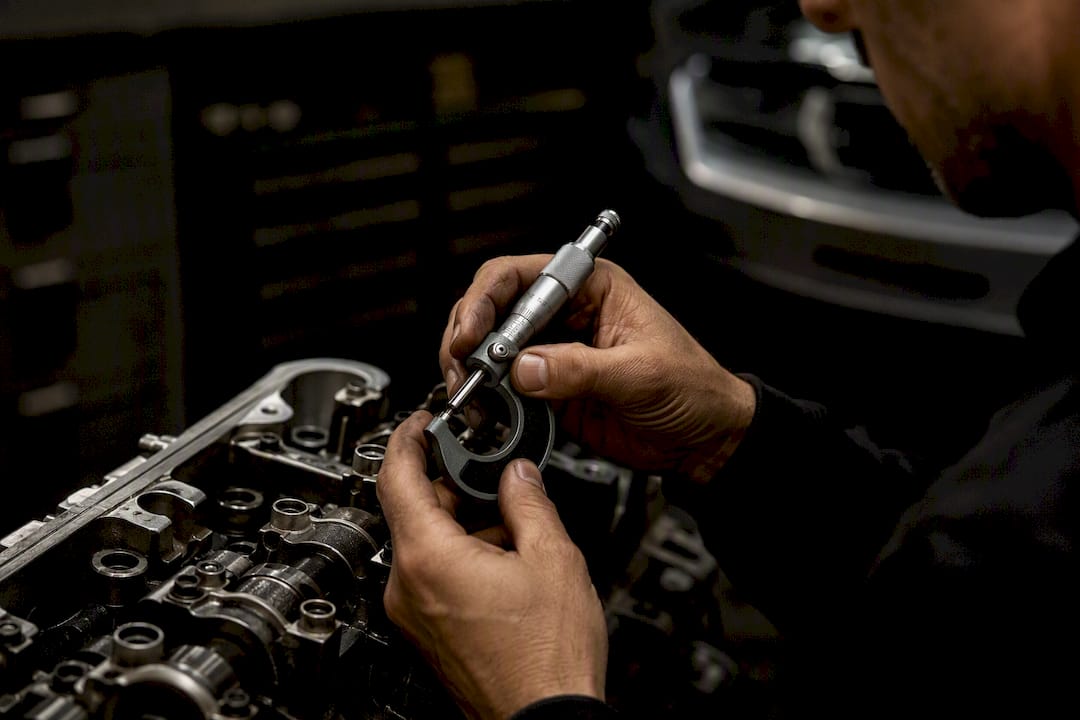
Labor rate is the first. Authorized dealers typically bill higher hourly rates than independent specialists, and complex jobs (anything requiring engine removal or AWD system access) rack up hours fast. A job quoted at 12 hours becomes a very different bill depending on whether your shop charges dealer rates or independent rates.
Parts availability matters just as much. OEM parts for current-production models ship quickly. Parts for a 2003 360 Modena can sit on backorder for weeks, and that lead time itself has a cost if your car sits idle.
Wear items scale with how you drive, not just how old the car is. Track days chew through tires and pads far faster than weekend cruising.
- Tires: aggressive driving can halve their lifespan
- Brake pads and rotors: track use accelerates wear dramatically
- Clutch (on manual or older automated-manual cars): city stop-and-go driving shortens service life
Hybrids add a category most owners don’t plan for: battery health checks and electronic control module diagnostics, which require dealer-level software and add line items that gas-only V8s and V12s simply don’t have.
Pro Tip: Ask any shop, dealer or independent, for a written estimate broken into labor hours and parts cost before approving work. Ferrari repair quotes vary enough between shops that a written breakdown lets you compare apples to apples.
Ferrari Maintenance Costs by Model and Age
Your car’s age and drivetrain tell you almost everything about what to expect on an annual basis. Here’s how the major categories break down.
Modern V8s like the F8 Tributo, 296 GTB, and Roma sit at the affordable end of Ferrari ownership. Authorized dealers typically charge $2,000 to $4,000 annually for scheduled service, while independent specialists often quote $1,200 to $2,500 for the same work.
V12 models, including the 812 Superfast and Purosangue, run higher across the board. Larger engines mean more oil volume and more spark plugs, and the tires and brakes on these heavier, more powerful cars wear faster and cost more to replace.
Hybrid models like the SF90 Stradale bring their own math. Dealer-side annual service on these cars commonly lands between $3,500 and $5,000, reflecting the added battery and electronics diagnostics beyond a standard oil-and-fluids visit.
Older belt-driven cars (360 Modena, F430, early 458 Italia) carry a cost most new owners underestimate: timing-belt engine-out service roughly every five years. This is one of the most labor-intensive jobs in the entire Ferrari lineup, since reaching the belts requires pulling the engine on some of these platforms, and dealer pricing for that single service runs $4,000 to $8,000, with independent specialists often coming in around $2,500 to $5,000.
Classic, pre-2000 Ferraris live in a different world entirely. Parts scarcity, specialist-only labor, and the age of underlying components mean full restorations can reach into six figures.
| Model group | Typical annual service (dealer) | Typical annual service (independent) |
|---|---|---|
| Modern V8 (F8, 296, Roma) | $2,000–$4,000 | $1,200–$2,500 |
| V12 (812, Purosangue) | $3,000–$5,500 | Not commonly quoted separately |
| Hybrid (SF90) | $3,500–$5,000 | Not commonly quoted separately |
| Belt-driven older V8 (360, F430, early 458) | $4,000–$8,000 (belt-service years) | $2,500–$5,000 (belt-service years) |
Most current-production Ferraris have shifted from timing belts to timing chains, which eliminates that recurring five-year expense entirely for newer buyers, and it’s one of the most overlooked cost advantages of buying a newer car over an older belt-driven one.
Common Major Repairs and What They Actually Cost
Routine maintenance is predictable. Major repairs are the part of Ferrari ownership that catches people off guard, because they’re rare but expensive when they happen.
- Clutch replacement: often $15,000 to $25,000 depending on model, more on cars with complex automated-manual systems
- PTU or AWD system rebuild: $30,000 to $50,000 on affected all-wheel-drive models
- Side head gasket replacement: typically $10,000 to $15,000
- Timing-belt engine-out service: $4,000 to $8,000 on applicable belt-driven models
None of these happen every year, which is exactly why they’re dangerous to a budget built only around routine service costs. The smart approach is treating them as a reserve fund rather than a surprise: set aside roughly what a major repair would cost divided across the years you expect between failures, and you’ll never face a five-figure bill with zero cushion.
- Rare and expected: clutch wear on high-mileage manual or F1-transmission cars, timing-belt service on scheduled intervals
- Rare and unexpected: head gasket failures, PTU issues outside typical wear patterns
Independent specialists can often shave real money off these bigger jobs too, though you should confirm in writing that any warranty coverage or resale documentation won’t be affected before sending a major repair to a non-dealer shop.
Dealer or Independent Specialist: Which One for Which Job
The right shop depends on what you’re getting done and what you plan to do with the car later.
Authorized dealers bring factory diagnostic software, guaranteed warranty compliance, and full documentation that matters at resale. If your car is still inside its complimentary maintenance window or under any Ferrari-backed warranty, dealer service usually isn’t optional. Hybrid and AWD electronic control module work also tends to require dealer-level tools that most independent shops don’t have access to.
Independent specialists earn their reputation on cost and craftsmanship. Shops staffed by former factory-trained technicians frequently deliver 25 to 40 percent savings on labor and total bill for routine service, without any meaningful drop in quality.
- Dealer: warranty-covered work, hybrid/electronic diagnostics, maximum resale documentation
- Independent: routine service after coverage ends, cost-sensitive owners, experienced ex-dealer technicians
Pro Tip: If you use an independent shop, keep every invoice and ask for detailed line-item receipts. A well-documented independent service history holds up fine at resale, but a folder of vague handwritten notes does not.
How to Lower Ferrari Ownership Costs Without Cutting Corners
Budgeting well beats reacting to surprises. Here’s the order of operations that actually reduces risk.
- Build an annual maintenance reserve. If you expect a $10,000 major repair sometime in the next five years, set aside $2,000 annually rather than hoping it doesn’t happen.
- Get a pre-purchase inspection on any used car, no exceptions. A few hundred dollars spent before purchase routinely catches issues that would cost thousands after.
- Favor Ferrari Approved (CPO) cars when price and availability allow. These typically come with extended coverage and a documented inspection history that lowers your unknown-repair risk.
- Weigh extended warranty cost against your real exposure. If you’re buying a car with a belt-service or PTU repair on the horizon, an extended warranty can pay for itself in a single event.
- Source parts smartly. Marketplaces built for exotic parts availability reduce both the price premium and the downtime you’d otherwise face waiting on a dealer backorder.
Owner-tracked spending data consistently shows that routine scheduled maintenance is rarely the biggest line item in total ownership cost. Insurance and depreciation dwarf it. The mistake most owners make isn’t overspending on oil changes. It’s under-reserving for the one big repair that eventually comes due.
How Supercars Cuts Parts Costs and Downtime
Sourcing the right part fast is half the battle in controlling repair costs, especially on older or less common models. Supercars built its marketplace around exactly that problem, listing more than 365,000 parts for Ferrari and other exotic marques in one searchable inventory.
- An AI-driven search feature helps you identify the exact part you need, cutting the guesswork that usually eats up hours on rare or discontinued components
- The scale of the catalog means backordered dealer parts often have a faster, cheaper equivalent listed and ready to ship
- Reduced parts lead time translates directly into less time your car sits idle waiting on a repair
Faster sourcing and AI-driven parts matching both point at the same underlying fix: the biggest hidden cost of exotic car ownership is often downtime, not the repair itself.
What the Numbers Actually Tell Ferrari Owners
Most advice on Ferrari ownership treats maintenance as the scary part. It isn’t. Scheduled service is predictable, and seven years of complimentary coverage removes most of the anxiety for anyone buying new. The real risk sits in two places people consistently underweight: the gap right after factory coverage ends, and the rare major component failure that has nothing to do with how well you maintained the car.
Conventional wisdom says “budget for maintenance.” Better advice says budget for the absence of maintenance problems, meaning reserve cash for the clutch, the PTU, the head gasket, the things that don’t happen on a schedule. That reframing changes how you save, not just how much.
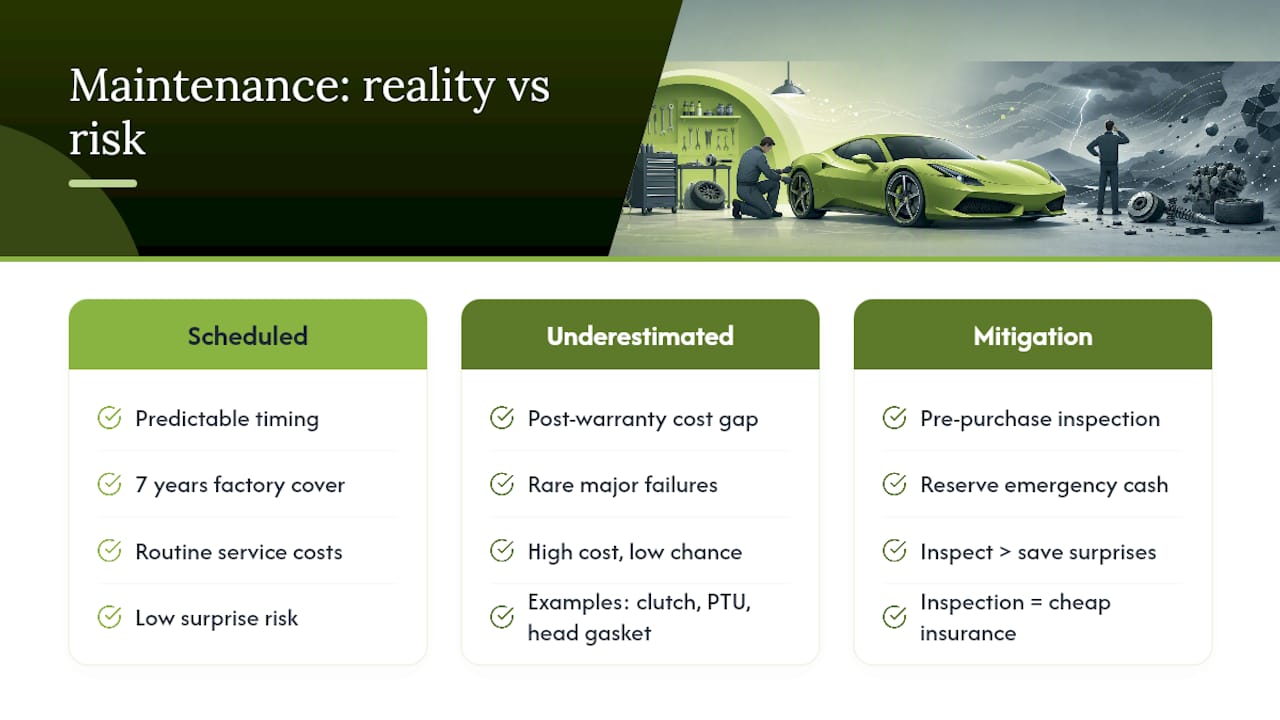
If you take one thing from this, prioritize the pre-purchase inspection over almost anything else. It’s the cheapest insurance you’ll ever buy against a five-figure surprise, and it tells you more about your actual cost exposure than any general cost range ever will.