Forged vs Cast Wheels: Which One Actually Fits Your Car
For pure performance and custom fitment, forged wheels are the top choice. Flow-formed wheels capture most of that benefit at a friendlier price. Cast wheels remain the cost-effective standard for daily drivers who never see a track. The real difference comes down to weight, grain structure, and how each wheel fails when pushed too far.
Weight tells most of the story: a 19x9.5 cast wheel typically runs 26 to 30 pounds, flow-formed drops to 22 to 26 pounds, and forged can hit 18 to 22 pounds for the same size. That’s not a minor spec difference. It changes how a car turns, stops, and rides over broken pavement.
- Track and competition: forged, for the strength-to-weight ratio and fatigue resistance under repeated impact
- Spirited street driving on a budget: flow-formed, for most of the performance gain at a fraction of the cost
- Daily commuting: cast, because OEM-grade reliability at the lowest price makes the most sense when you’re not chasing lap times
Key Takeaways
Forged wheels win on strength and weight, flow-formed wins on value, and cast wins on upfront cost, with the right choice depending entirely on how hard you drive.
| Point | Details |
|---|---|
| Weight gap is real | A 19x9.5 forged wheel can weigh 18–22 lb versus 26–30 lb for cast, affecting handling and braking. |
| Failure modes differ | Forged wheels tend to bend under impact; cast wheels are more prone to cracking. |
| Flow-formed is the value play | It delivers much of forging’s benefit at a lower price and shorter lead time. |
| Verify before buying | Check for JWL, VIA, or TUV certification stamps and request alloy and heat-treatment details. |
| Source fitment carefully | Supercars.parts uses AI-driven search across 365,000+ listings to match OEM-correct wheels for exotic cars. |
Table of Contents
- Forged vs Cast Wheels: What Actually Separates Them
- How Do Forged, Flow-Formed, and Cast Wheels Compare Side by Side?
- How to Choose the Right Wheel Construction for Your Car
- Repair, Maintenance, and Ownership Realities
- Sourcing Forged and OEM Wheels for Exotic Cars
- Find the Right Wheels for Your Exotic on Supercars
- Sources
Forged vs Cast Wheels: What Actually Separates Them
The phrase “forged vs cast wheels” gets thrown around a lot, but the technical distinction is about how the aluminum itself gets shaped, not just the finished look. Cast wheels start as molten aluminum poured into a mold. Forged wheels start as a solid billet that gets compressed under enormous pressure until the metal’s internal grain structure aligns and tightens. That single difference in process cascades into everything else: weight, strength, cost, and how the wheel behaves when it fails.
Casting comes in a few flavors, and the method matters more than people assume. Gravity casting is the cheapest, using nothing but gravity to fill the mold, and it’s fine for low-stress applications but prone to trapped air pockets. Low-pressure casting, the most common approach for OEM wheels, forces molten aluminum (often A356 alloy) into the mold under controlled pressure, producing more consistent density. Counter-pressure casting goes a step further, pressurizing the mold from both directions to minimize porosity. Casting quality and alloy choice determine whether a cast wheel actually meets service requirements, which is why two cast wheels that look identical can perform very differently under load.
Flow forming (sometimes called rotary forging) splits the difference. The wheel’s face is still cast, but the barrel gets heated and spun at high speed while rollers compress and stretch the metal outward. That process refines the grain structure in the barrel specifically, cutting barrel weight by roughly 15 to 20 percent compared to a fully cast wheel. It’s a clever middle path: you get a stronger barrel without paying for a wheel that’s forged end to end.
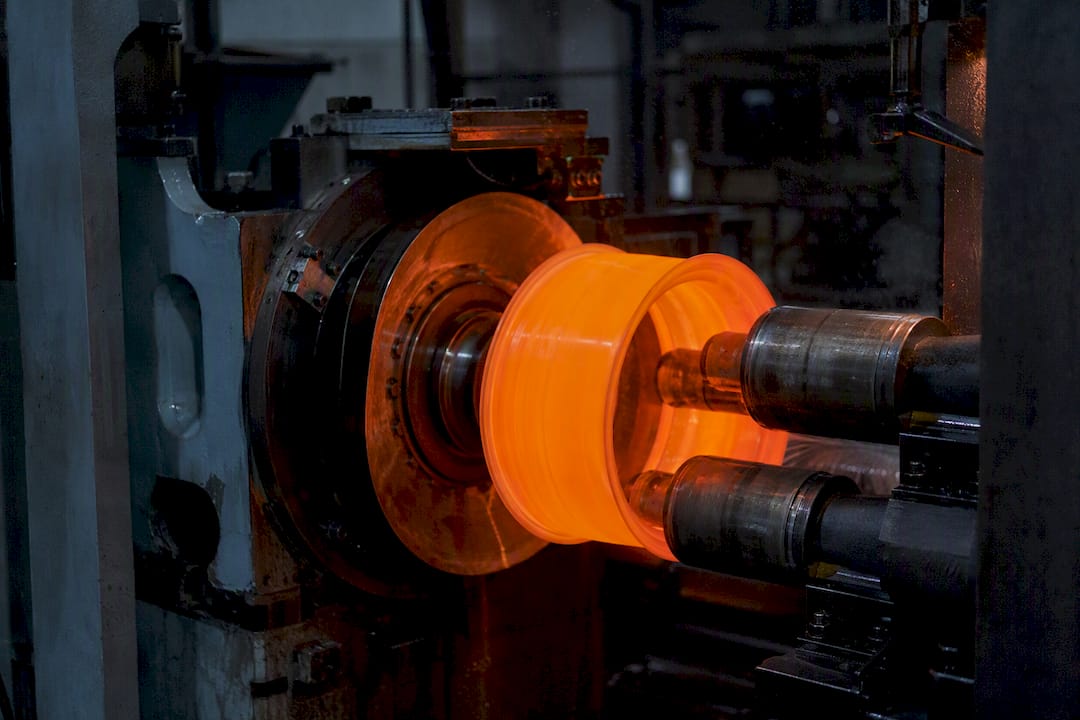
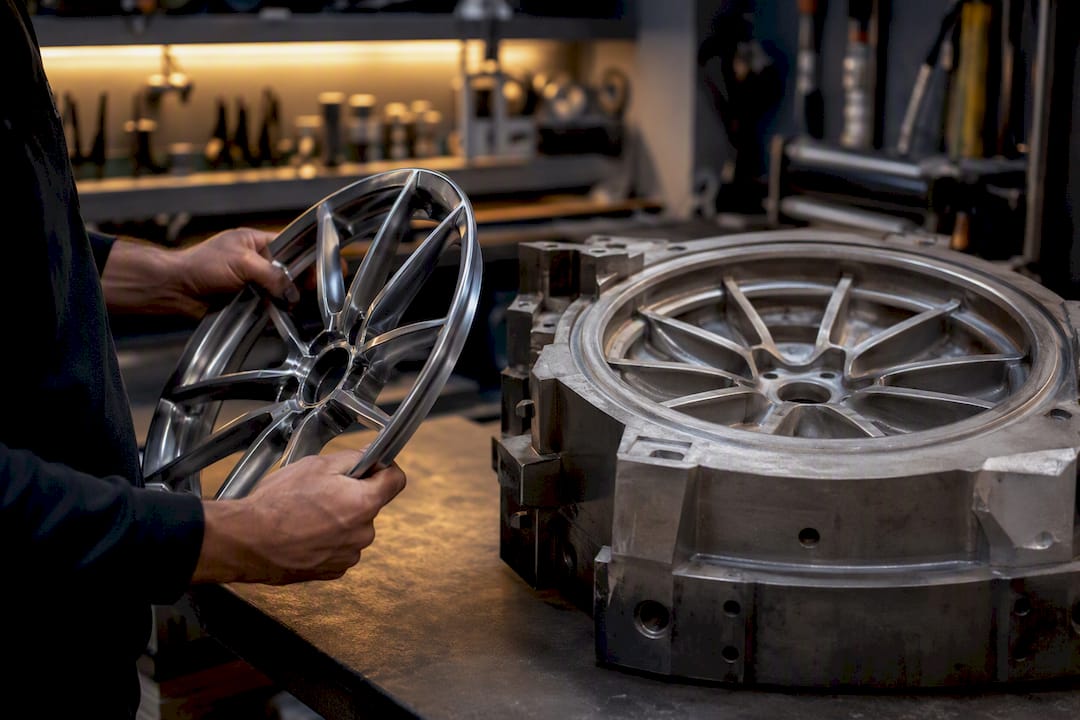
Forging starts with a solid puck of 6061-T6 aluminum billet, no molten metal involved. A hydraulic press, sometimes exceeding 10,000 tons of force, squeezes that billet through multiple stages until it takes rough wheel shape. Then a CNC lathe cuts the final geometry, spokes, and mounting surfaces. Because the metal was never liquefied, there’s no porosity to worry about, and the compression aligns the grain structure along the wheel’s stress lines.
Here’s the sequence that makes forging different from casting, start to finish:
- Billet selection and heating (typically 6061-T6 aluminum)
- Multi-stage press forging under extreme pressure
- Heat treatment to lock in strength properties
- CNC machining for final spoke and barrel geometry
- Finishing (polishing, anodizing, or powder coating)
Pro Tip: If a seller can’t tell you which casting method or alloy spec their wheel uses, that’s a red flag worth walking away from, especially on anything going near a track.
How Do Forged, Flow-Formed, and Cast Wheels Compare Side by Side?
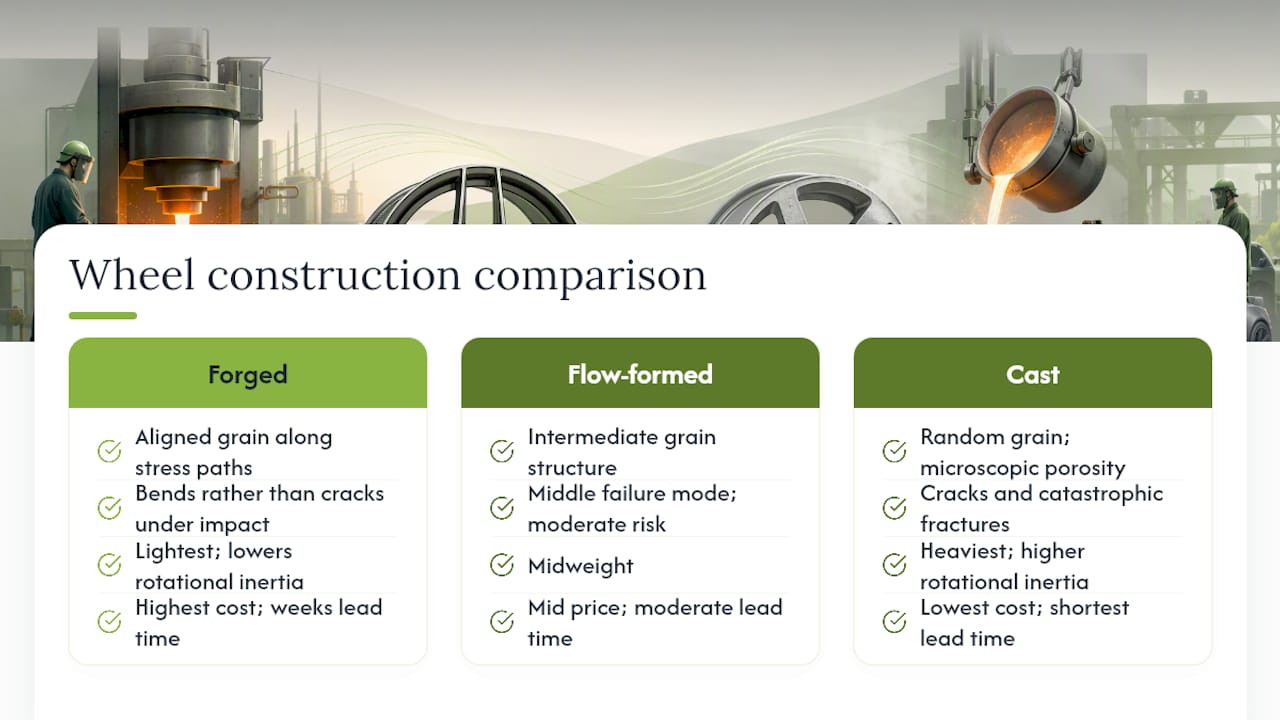
Numbers make this comparison concrete. For an identical 19x9.5 wheel, here’s how the three constructions stack up:
Forging aligns the metal’s grain structure along the wheel’s stress paths, which is why forged wheels tend to bend under extreme impact rather than crack. Cast wheels, by contrast, have a more random grain structure with microscopic porosity baked in from the casting process. Under a hard enough hit, that porosity becomes a starting point for cracks rather than deformation. It’s the difference between a wheel that dents and one that fractures.
That failure-mode gap matters more than it sounds. A bent forged wheel on track often lets a driver limp back to the pits safely; a cracked cast wheel can fail catastrophically with little warning. That’s part of why forged wheels dominate professional motorsports despite costing dramatically more.
Weight differences also ripple into how a car actually drives. Wheels are unsprung mass, meaning the suspension has to control them directly with no cushioning from springs or dampers. Every pound saved at the wheel has a bigger effect than a pound saved in the chassis, because that mass also contributes to rotational inertia, the resistance to spinning up or slowing down. Motor1’s coverage of forged wheel construction notes that lighter wheels translate to quicker acceleration, shorter braking distances, and sharper steering response, particularly noticeable on cars already pushing serious power or lap times.
None of this comes free. Forged sets take longer to produce, often several weeks for custom fitments, and cost several times what a comparable cast set runs. Flow-formed wheels sit in the middle on every axis: price, weight, and lead time. For most enthusiasts who aren’t chasing tenths of a second, that middle ground is exactly where the value lives.
How to Choose the Right Wheel Construction for Your Car
Start with an honest assessment of what you actually do with the car, not what you imagine doing with it. A checklist helps cut through the temptation to overbuy:
- Use-case: Track days and autocross favor forged; street driving and commuting rarely need it.
- Tire profile and fitment: Low-profile setups on wide, custom offsets often require forged for structural reliability at thin sidewalls.
- Vehicle torque and weight: High-horsepower or heavy vehicles (large SUVs, trucks towing loads) put more stress on the wheel barrel and benefit from forged or flow-formed construction.
- Budget: Cast wheels win on pure cost-per-wheel; forged wins on cost-per-performance-gain for serious drivers.
- Finish preference: Forged wheels often come in exotic finishes (brushed, exposed forged texture) that cast production can’t replicate.
When you’re talking to a seller, ask direct questions: What casting method or forging process was used? What alloy spec, and was it heat-treated afterward? What’s the load rating, and does it carry certification stamps like JWL, VIA, or TUV? What warranty applies, and does the finish require special maintenance?
Pro Tip: Are forged wheels worth it for your situation? If you’re building a dedicated track car or restoring an exotic to factory-correct spec, yes, almost always. If you’re daily-driving a street car with occasional canyon runs, flow-formed usually delivers better value per dollar than paying forged prices for gains you’ll rarely use.
Flow-formed is the pragmatic pick for most enthusiasts. It closes much of the performance gap at a price point that doesn’t require justifying the purchase to your accountant. Forged makes sense when custom fitment, maximum strength, or motorsport use is genuinely part of the plan. Cast remains the right call for OEM-matching restorations or budget builds where reliability, not lap time, is the goal.
Repair, Maintenance, and Ownership Realities
Not every wheel damage story ends the same way, and that’s worth knowing before you buy. Some cast wheels can be welded or straightened depending on the alloy and how severe the damage is, though a qualified shop should always make that call. Forged wheels can sometimes be repaired too, but they demand more specialized inspection because their fatigue behavior and finishing are harder to restore correctly.
After any hard impact, curb strike, or pothole hit, run through this sequence:
- Visual inspection for cracks, gouges, or bent lips
- Runout check on a balancer to catch out-of-round conditions invisible to the eye
- Nondestructive testing (dye penetrant or ultrasonic) at a specialist shop when structural integrity is in question
Expensive forged finishes, brushed aluminum, exposed polish, custom anodizing, scratch and corrode more visibly than a factory clear-coated cast wheel. A ceramic coating protects the finish and cuts down on the frequent detailing that premium finishes otherwise demand.
Pro Tip: Forged sets carry a higher theft risk simply because they’re worth more on the resale and black market than cast equivalents, so factor locking lug nuts or garage storage into your ownership plan.
How to Tell If a Wheel Is Forged or Cast
Buyers get misled on this more often than you’d expect, sometimes by accident, sometimes not.
- Check the wheel’s inner barrel or spoke face for stamped certifications (JWL, VIA, TUV) and request the vendor’s datasheet.
- Weigh the wheel and compare it against known cast or forged weights for that exact size; a 19x9.5 under 22 pounds is almost certainly forged.
- Look closely at machining marks, cast wheels often show mold seams or slightly rougher finishing inside the barrel.
- Ask directly for the alloy grade and whether heat treatment was applied after shaping.
Sourcing Forged and OEM Wheels for Exotic Cars
Finding correctly specified wheels gets harder the rarer the car. A Ferrari or Lamborghini fitment isn’t interchangeable with generic aftermarket sizing, and getting the offset or bolt pattern wrong on a forged set is an expensive mistake. Supercars.parts lists over 365,000 parts listings, with AI-driven search built to match exact OEM specs across brands like Ferrari, Lamborghini, McLaren, and Rolls-Royce. For restorers and owners chasing factory-correct fitment, that specificity matters more than a generic wheel that “should fit.”
— Artem
Find the Right Wheels for Your Exotic on Supercars
Sourcing a correctly specified wheel set for a Ferrari, Lamborghini, or Aston Martin usually means digging through forums, calling specialty shops, and hoping someone still has the right offset in stock. Supercars.parts cuts that search down by giving you a single marketplace with over 365,000 listings and AI-powered search that matches OEM specs directly to your chassis, whether you need factory-cast wheels for a restoration or a forged upgrade set for track use.
If you’re not sure whether your car takes a cast, flow-formed, or forged wheel from the factory, search your model on Supercars or reach out for fitment help before you buy. Getting the spec right the first time beats returning a wheel that almost fit.