
Five Step Part Number Decoding for Parts Buyers, Avoid Costly Mistakes
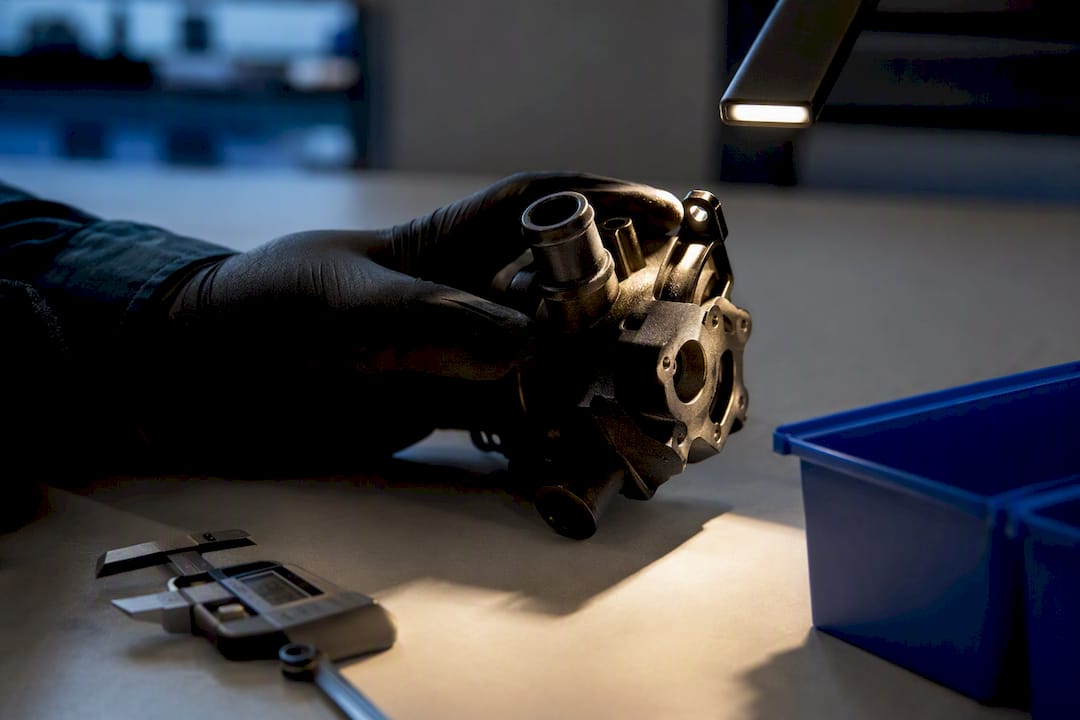
Decoding a part number splits a string into segments that usually point to a product family and a specific variant or configuration, but the exact rules depend entirely on the manufacturer. The moment you have a number in hand, break it into its prefix, base, and suffix blocks, then run that base segment through the maker’s own catalog or datasheet. Suffix letters and interchange listings are useful clues. They are not confirmation of fitment.
TL;DR:
- Proper decoding requires recognizing the format, splitting into prefix, base, and suffix, and verifying each part with manufacturer-specific guidelines.
- Suffix meanings vary greatly across brands, with TE connectors focusing on pin/position counts and Ford or Mercedes indicating configuration, revision, or packaging details.
- Confirm parts through official catalogs, datasheets, and actual label photos to avoid costly ordering mistakes caused by assumptions based solely on part number segments.
- Relying on interchange numbers or marketplace SKUs as fitment proof can lead to errors; always cross-reference the OEM part number or drawing for accurate verification.
- Use verified online tools like Supercars.parts after decoding to quickly find confirmed listings, but always request seller photos and confirmation before purchasing rare or discontinued components.
Table of Contents
- What Part Number Decoding Actually Tells You
- How Do You Decode a Part Number Step by Step?
- How Ford, Mercedes, Siemens, and Connector Makers Structure Their Codes
- Which Tools Actually Confirm a Decoded Part Number?
- What Mistakes Cause the Most Wrong Orders?
- Where Supercars.parts Fits Into the Decoding Process
- A Sourcing Note on Trusting the Dash Too Much
- Find Verified Listings Once You’ve Confirmed the Number
- Sources
What Part Number Decoding Actually Tells You
Part number decoding is the process of reading a manufacturer’s alphanumeric code to figure out what a component is, what family it belongs to, and how one version differs from another. Some people call this parts identification or a part number lookup, and both terms describe the same practical skill: turning a string like “DT06-2S” or “6ES7 214-1AG40-0XB0” into usable specs.
The catch is that no universal grammar governs these codes. Ford, Mercedes, Siemens, TE Connectivity, and Deutsch each built their own numbering logic, often decades apart, for different engineering reasons. A dash in a TE connector number might mean something completely different from a dash in a Mercedes part number. That is why decoding is a repeatable process, not a lookup table you memorize once and reuse everywhere. The next section walks through that process step by step.
How Do You Decode a Part Number Step by Step?
Every part number, regardless of manufacturer, responds to the same five-step approach. Skipping a step is usually where costly ordering mistakes start.
- Recognize the format first. Look for dash blocks, letter groups, and numeric families before you try to interpret anything. A number like YL34-14B205-CA reads very differently once you notice it has three distinct segments separated by dashes, rather than one long string.
- Split it into prefix, base, and suffix. Note the separators exactly as printed. Spacing and dash placement often change meaning between manufacturers, and even within one manufacturer’s own catalog across model years.
- Ask what kind of object you’re looking at. Is it a housing, a terminal, a module, a fastener, or a full assembly? This single question prevents most of the suffix-interpretation errors that trip up even experienced buyers, because the same dash position can mean pin count on one part type and plating on another.
- Run an authoritative lookup. Check the manufacturer’s electronic parts catalog (EPC), datasheet, or official portal. If no direct match turns up, treat any OE numbers, MPNs, or interchange listings you find as candidates, not answers.
- Confirm the fine print before ordering. Match the drawing number, spec sheet, packaging, plating, and revision code against what you actually have in hand.
Enterprise IT procurement teams already run a version of this workflow. Systems that handle part identification at scale route each vendor’s format to the correct authoritative lookup and flag unverifiable near matches as no match, rather than guessing. That conservative instinct is worth copying whether you’re sourcing a server part or a Ferrari brake caliper.
- Prefix segments often encode design year, product line, or family.
- Base numbers anchor the drawing family and rarely change across minor revisions.
- Suffix blocks carry the highest risk of misreading, since their meaning shifts by product type and even by manufacturer department.
Pro Tip: Photograph the physical part number before you clean, paint, or repackage anything. Stamped or printed digits fade fast, and you’ll want that image on file the moment a listing description doesn’t quite match what you’re holding.
How Ford, Mercedes, Siemens, and Connector Makers Structure Their Codes
Manufacturer-specific patterns are where decoding automotive part numbers gets genuinely useful, because once you recognize a brand’s grammar, you can decode similar numbers from that brand much faster.
TE Connectivity numbers group around a base number that anchors a drawing family, with prefix and dash suffixes layered on top. The dash logic changes depending on whether you’re looking at a housing or a terminal: for housings, the suffix often maps to pin or position count, while for terminals it typically points to plating or packaging quantity. A base number like 178128 might appear across a whole family of connector variants, and TE’s own numbering conventions only make sense once you know which object type you’re reading.
Deutsch connectors use letter prefixes and suffixes that can change seal type, shell color, or internal wiring configuration. Take DT06-2S: the “DT” identifies the series, “06” points to shell size, “2” gives the cavity count, and the “S” tells you it’s a socket housing rather than a pin housing. Swap that final letter and you’ve ordered the wrong half of the mating pair.
Ford part numbers follow a three-block structure: a prefix tied to design year or product line, a basic number, and a suffix indicating revision or configuration. YL34-14B205-CA breaks down as a design-year/platform code, a basic part number, and a revision suffix, and Ford’s own numbering guidance confirms there’s no shortcut around checking the suffix against the actual application.
Mercedes-Benz groups its numbers into a single-letter prefix followed by 10 digits, sometimes trailed by an ES1 or ES2 suffix. A number like A 117 030 10 17 follows this pattern, and the ES suffix codes can indicate packaging, remanufactured status, or trim and color detail. Spacing matters here more than most buyers expect.
Siemens MLFB codes lead with a family prefix, so 6ES7 identifies a SIMATIC S7 PLC before you’ve read a single other digit. Siemens’s own MLFB structure puts hardware and firmware revision detail later in the string, which means family-level decoding is fast, but full revision confirmation still requires the official portal.
| Manufacturer | Structure | What the suffix typically tells you |
|---|---|---|
| TE Connectivity | Prefix + base + dash suffix | Position count (housings) or plating/packaging (terminals) |
| Deutsch | Series prefix + size + cavity + suffix letter | Pin vs. socket, seal, or wiring configuration |
| Ford | Prefix + basic number + suffix | Design year/platform, then revision or configuration |
| Mercedes-Benz | Letter + 10 digits + optional ES suffix | Packaging, reman status, or trim/color |
| Siemens (MLFB) | Family prefix + remaining digits | Product family first, then hardware/firmware revision |
The dash-suffix mismatch between TE housings and terminals is one of the most frequent causes of a wrong part landing on a technician’s bench, according to TrustCompo’s connector decoding guide. It’s a small distinction with an outsized cost when it’s missed.
Which Tools Actually Confirm a Decoded Part Number?
Decoding gets you a strong guess. Verification is what turns that guess into a part you can safely order.
- Go to the manufacturer’s own catalog first. OEM electronic parts catalogs (EPCs), Siemens SiePortal, the Siemens Industry Mall, and manufacturer product pages carry the authoritative version of any number you’re trying to confirm.
- Use VIN lookups for vehicle-specific fitment, but know their limits. A VIN can confirm which chassis or trim a body part fits, but it often can’t tell you which calibration or option-set variant an electronic module needs. Suffix letters on used control modules frequently encode exactly that kind of calibration difference, which is why matching by base number alone is a common and expensive mistake.
- Treat interchange tables and community decoders as leads, never as final answers. Interchange numbering systems group functionally similar parts to help you find candidates faster, but they were never designed to certify fitment. The same caution applies to public MLFB decoder tools: they’re reliable for identifying a family, less reliable for confirming every digit of a revision code.
- Before you buy, request the datasheet, the drawing number, and photos of the actual label. Log what you receive against what the listing claims. This single habit catches more sourcing mistakes than any decoding skill on its own.
Understanding OEM fitment versus aftermarket equivalents helps frame why this verification step matters so much: a part can look correct on paper and still be the wrong fitment in practice.
Pro Tip: Keep a simple spreadsheet log of every part number you verify: the string, the source you confirmed it against, and the date. Six months later, when a similar number shows up, you’ll have your own reference instead of starting from zero.
What Mistakes Cause the Most Wrong Orders?
Most part number mistakes come from treating a partial match as a full match. A few patterns show up again and again.
- Assuming suffix letters are interchangeable, especially on electronic modules where a single letter can represent a different calibration or option set entirely.
- Trusting a seller’s internal SKU or marketplace listing ID as proof of fitment. It’s an inventory tag, not a manufacturer reference.
- Misreading connector dash suffixes by not first confirming whether you’re looking at a housing or a terminal, since the same dash position carries different meaning for each.
- Relying on an interchange number without validating it against the OE or MPN and the actual drawing, since interchange groups are candidates, not confirmations.
A short pre-purchase checklist covers most of this ground: match the exact string, confirm the drawing or spec sheet, request label photos, check packaging and plating details, verify the production or design year, and cross-reference with the OEM or a verified seller. Buyers who skip straight from a suffix guess to a purchase are the ones who end up re-shipping parts. Running through even a partial version of this checklist catches the majority of avoidable mismatches before money changes hands.
Where Supercars.parts Fits Into the Decoding Process
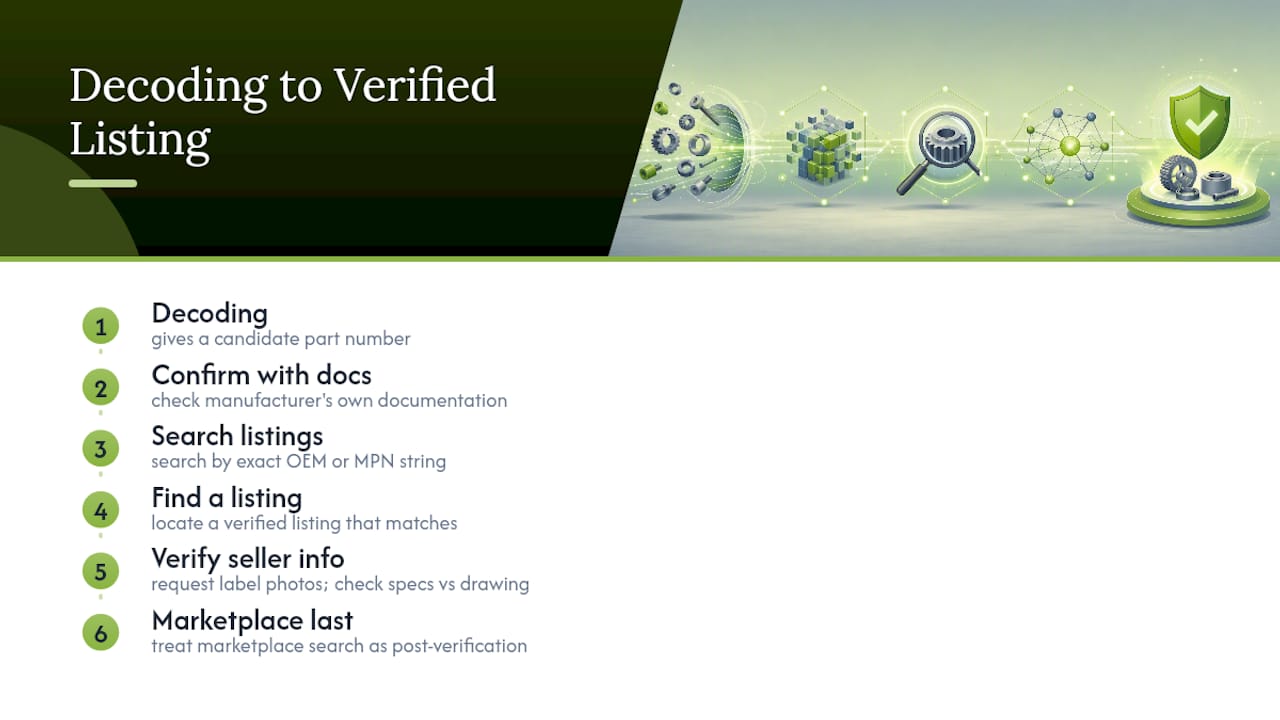
Decoding gives you a candidate part number. The next move is finding a verified listing that actually matches it. That’s the gap Supercars is built to close, with an AI-driven search across more than 365,000 listings covering OEM and aftermarket components for marques like Ferrari, Lamborghini, McLaren, Aston Martin, and Rolls-Royce.
The workflow stays the same regardless of tool: decode the number, confirm it against the manufacturer’s own documentation, then search by that exact OEM or MPN string. Once you find a listing, request photos of the physical label and ask the seller to verify specs against the drawing before you commit. Treat the marketplace search as the step after verification, not a replacement for it.
A Sourcing Note on Trusting the Dash Too Much
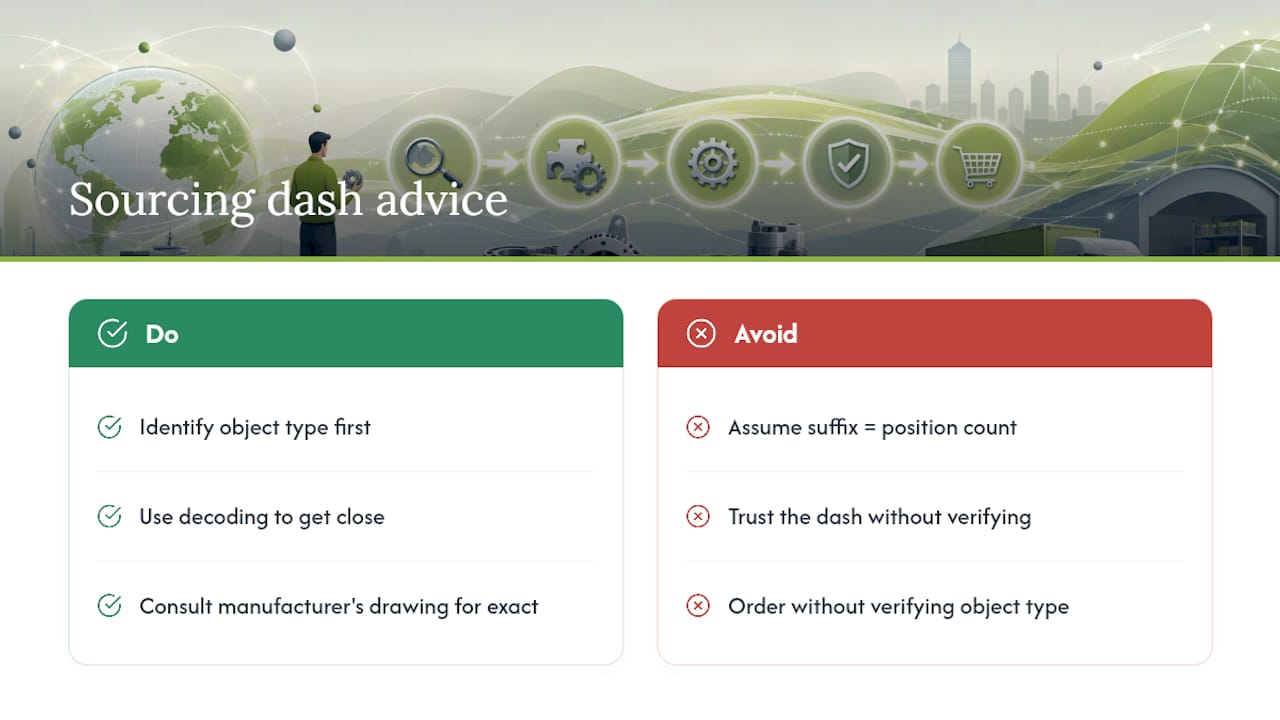
A connector order I once reviewed went sideways over a single dash. The buyer read a TE terminal suffix as a position count, the way housing suffixes usually work, and ordered the wrong plating variant entirely. The base number matched. The object type didn’t.
That’s the habit worth building: identify whether you’re looking at a housing, a terminal, or an assembly before you try to interpret anything after the dash. Decoding gets you close. Only the manufacturer’s own drawing gets you exact.
— Artem
Find Verified Listings Once You’ve Confirmed the Number
Such platforms give you a faster route to the exact part than scrolling forums or cold-calling specialty shops, once you’ve done the decoding work above. With AI-driven search across a very large inventory of exotic and supercar parts, you can type in a confirmed OEM number or MPN and skip the generic keyword guessing that wastes hours on other platforms.
After you’ve split the string, checked the manufacturer’s catalog, and settled on a confirmed OEM or MPN, search that exact number on Supercars.parts. Request label photos and seller verification before you buy, especially on rare or discontinued components where a near match can be tempting but wrong. Start your search now at Supercars and get the number in front of sellers who actually carry it.


