
VIN Accurate Rolls-Royce Part Numbers: Verify and Source for Restorers
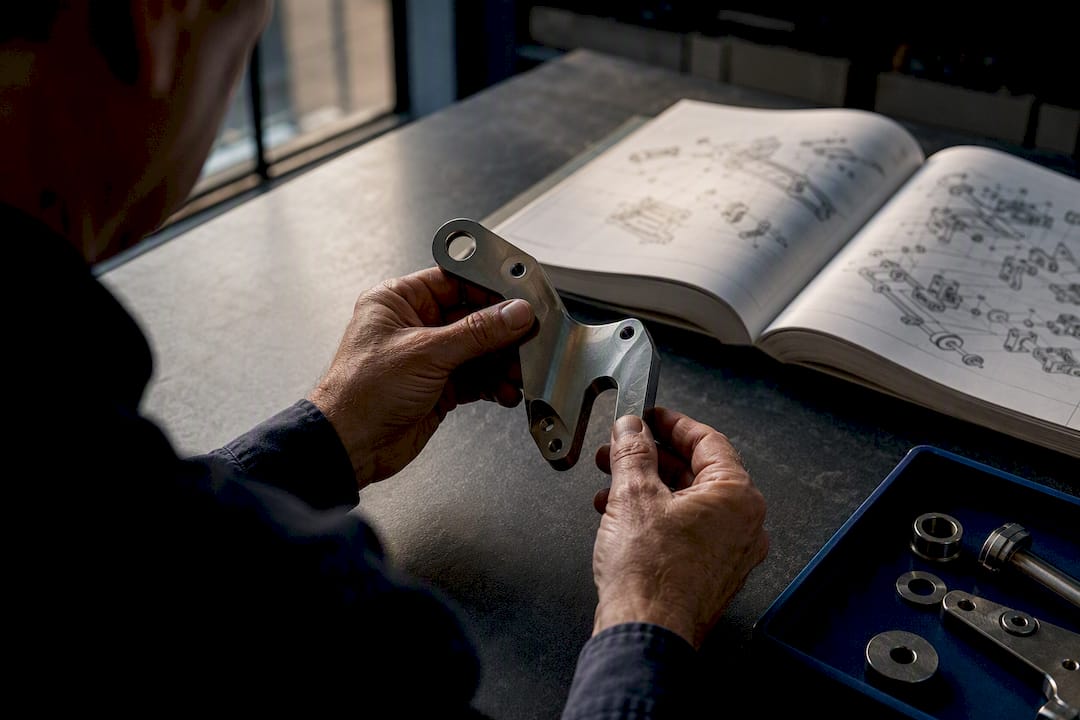
The most reliable way to find genuine Rolls Royce part numbers is through ETK/RealOEM-style catalog mirrors like 7zap and Catalogs Parts, both of which host exploded diagrams tied to OEM numbers by series and generation. Before you buy anything, confirm your VIN and generation match the catalog entry, then check the number against the stamped or cast marking on the actual component. A catalog row plus a supplier’s fitment confirmation beats trusting a single marketplace listing every time.
TL;DR:
- Using VIN and generation lookup ensures you access the correct exploded diagram for your specific Rolls-Royce build, avoiding mismatched parts from generic catalogs.
- Cross-referencing OEM numbers with stamped component markings, production dates, and supersession flags is crucial to prevent ordering incompatible or superseded parts.
- Verifying physical parts with catalog data before purchase reduces costly errors, as appearance and markings on the actual component are the final confirmation.
- Online catalogs like 7zap and specialized marketplaces use structured OEM number formats and AI tools to help locate hard-to-find or superseded parts efficiently.
- Always record detailed OEM numbers, supersession notes, and supplier responses to streamline sourcing and reduce repeat ordering mistakes.
Table of Contents
- How Factory Parts Catalogs and Exploded Diagrams Are Organized
- Using VIN and Generation Lookup to Get VIN-Accurate Part Numbers
- Reading Diagram Callouts, Parts-List Rows, and Supersessions
- Practical Verification Steps Before Ordering a Part
- Where to Find OEM Numbers and Diagrams
- How Supercars.parts Helps Source and Verify Rolls-Royce OEM Numbers
- Understanding the Structure and Format of Rolls-Royce Part Numbers
- Common Prefixes and Suffixes in Part Numbers and Their Meanings
- How to Identify Counterfeit or Incorrect Part Numbers
- Cross-Referencing Rolls-Royce Part Numbers With Aftermarket Alternatives
- Tips for Using Part Number Databases and Online Resources Effectively
- Practitioner Perspective: Why Verification Beats Blind Ordering
- Search by OEM Number or VIN on Supercars.parts
- Sources
- FAQ
How Factory Parts Catalogs and Exploded Diagrams Are Organized
Every legitimate Rolls-Royce parts catalog follows roughly the same navigation path: series, then generation, then assembly group, then the exploded diagram itself, then the parts-list row where the OEM number actually lives. Skip a step and you’ll likely land on the wrong diagram entirely, especially since Rolls-Royce revises exploded views whenever a facelift or LCI update changes even a bracket or fastener.
Generations get their own separate catalog cards for a reason. A Phantom built in one production run can carry a different bumper support or wiring harness than one built two years later, even under the same model name. Catalogs like the ETK/RealOEM-style mirrors split these out deliberately so you’re never guessing which diagram applies.
Once you’re in the correct exploded view, the diagram callouts (usually small numbered flags pointing at individual components) link to rows in an adjacent parts list. Those rows typically include:
- The OEM part number itself
- A short parts description
- The quantity required per assembly
- Notes on trim level, options, or production date ranges
- Supersession flags when the part has been replaced by a newer number
Learning to read that row correctly is the difference between ordering a part that fits and ordering one that almost fits.
Using VIN and Generation Lookup to Get VIN-Accurate Part Numbers
A model name alone will not tell you which part your car actually needs. Rolls-Royce, like most manufacturers, makes running changes mid-production, so two cars built in the same calendar year can require different OEM numbers depending on build date and factory-installed options. VIN-accurate lookup resolves that ambiguity because it ties the catalog entry to your specific build, not just your model year.
Here’s the practical sequence:
- Locate your VIN on the door jamb plate, engine bay identification tag, or registration documents.
- Enter or match that VIN against the generation selector in your catalog of choice, narrowing from series to the specific production window.
- Open the VIN-accurate exploded diagram for the assembly you need, rather than a generic version for the model line.
- Check for LCI or facelift-specific entries, since these often carry separate diagrams even within the same generation.
- Cross-reference any listed option codes (climate package, wheel spec, interior trim) against your build sheet if the part varies by equipment.
Some catalog sites, including certain OEM parts portals, require you to create an account or submit your VIN before they’ll reveal the full parts list for newer models. That extra step is usually worth it, since it filters out irrelevant diagrams before you even start browsing.
Reading Diagram Callouts, Parts-List Rows, and Supersessions
A callout number on an exploded diagram is a locator, not automatically an orderable part number. The callout points you to a row in the adjacent list, and that row is where the actual OEM code, description, and quantity appear. Confusing the two is one of the most common mistakes new restorers make, and it’s an easy way to order the wrong index clip instead of the part you actually need.
Supersession notes are just as important to catch. When Rolls-Royce or a supplier replaces a part number, most catalog mirrors flag the original number and list the current equivalent, according to the 7zap catalog reference. Sometimes that’s a straight swap; other times the superseding part covers a broader range of chassis or model years than the original did.
When you find the right entry, record these details before you close the tab:
- Diagram page or assembly group reference
- Callout index number
- The OEM part number itself, plus any superseded number it replaces
- Required quantity
- Any catalog notes on trim, options, or production dates
That five-point record is what you hand to a supplier or search against a marketplace listing later. Skip it, and you’ll be re-digging through the same diagram in a week.
Practical Verification Steps Before Ordering a Part
Catalog research gets you close. Physical verification is what actually prevents a returned part sitting in a box on your workbench for three weeks. Here’s the sequence worth following every time, regardless of how confident the catalog entry looks:
- Remove the old component if it’s accessible, and inspect it for a stamped or cast part number, date code, or manufacturer mark.
- Photograph the number and the surrounding area before cleaning or repainting anything.
- Cross-check that stamped number against the catalog row you found, and against your VIN-generation lookup, to confirm they agree.
- Contact the supplier with the OEM number, your VIN, and the diagram reference, and ask directly whether the part has been superseded.
- Confirm the seller’s return policy before paying, in case the physical part doesn’t match once it arrives.
Pro Tip: Keep a simple spreadsheet with columns for OEM number, superseded number, VIN range, and supplier response. Restorers who track this across a full project rarely reorder the same part twice.
Verification only takes a few extra minutes. A wrong part shipped across the country and back costs considerably more than that, in both time and money.
Where to Find OEM Numbers and Diagrams
Modern Rolls-Royce models are well covered by ETK/RealOEM-style catalog mirrors with generation selectors built in, letting you narrow from series to production window before you ever open a diagram. Sites like Catalogs Parts organize these by chassis code, which is faster than browsing by model year alone.
Classic and pre-war Rolls-Royce cars are a different story. Modern online catalogs frequently don’t cover cars from that era in any depth, so historic printed schedules and scanned parts booklets become the primary reference, according to Flying Spares’ catalog archive. Restorers working on Silver Shadows, Corniches, or earlier chassis often rely on these scanned documents specifically because nothing else exists in digital form.
Commercial supplier catalogs fill the gap between the two. Specialist databases aggregate OEM numbers, track supersessions, and often show live stock, which makes them genuinely useful once you already know the number you’re chasing rather than starting your search there.
How Supercars.parts Helps Source and Verify Rolls-Royce OEM Numbers
Once you have a confirmed OEM number, sourcing it is its own challenge, especially for parts that have been superseded or discontinued. Some specialist marketplaces run AI-driven searches that can match an OEM number, a VIN, or even an uploaded photo of the component against extensive inventories, which can improve your odds of turning up a rare or superseded part that a generic search would miss.
Use it the way you’d use any specialist supplier: come in with your VIN and diagram reference ready, not just a model name. When you message a seller, include the OEM number, the superseded number if one exists, and a photo of the stamped part if you have it. That context is what turns a maybe into a confirmed fitment before money changes hands.
Understanding the Structure and Format of Rolls-Royce Part Numbers
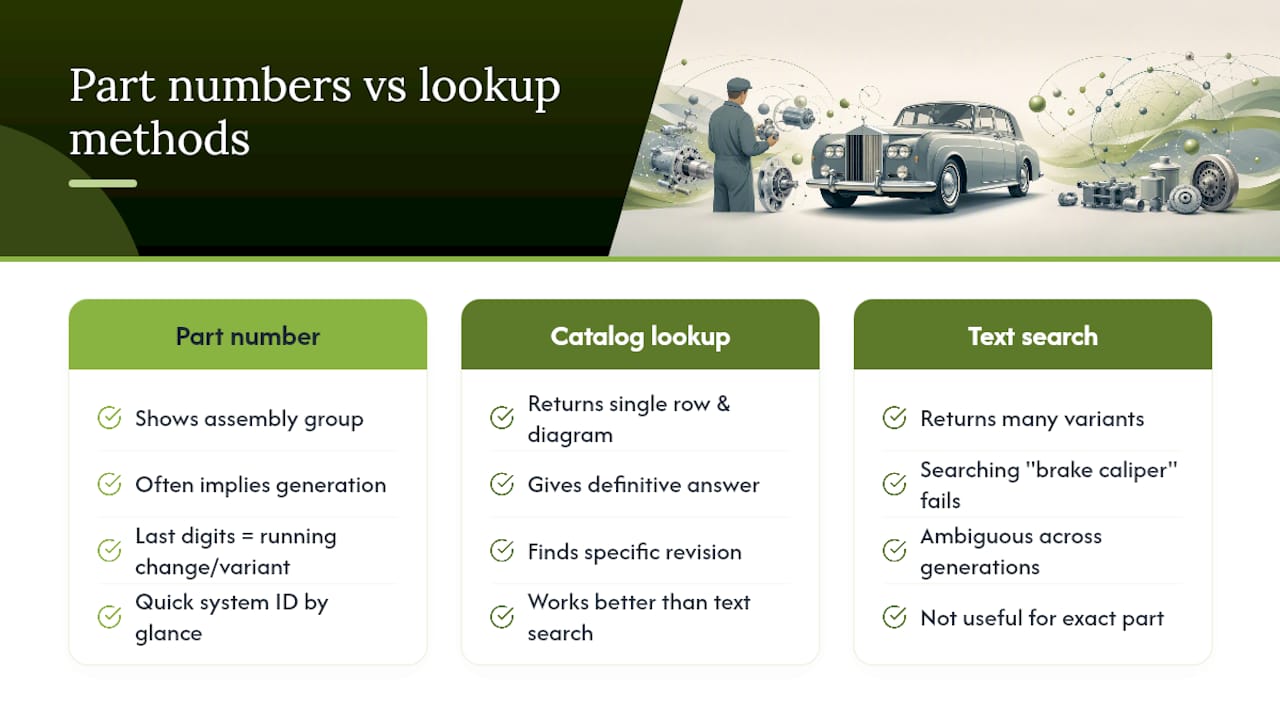
Rolls-Royce OEM numbers generally follow a structured format tied to the assembly group and revision status of the part, rather than a random sequence. Most modern numbers run as a string of digits, often grouped in blocks, that map to a specific assembly category in the catalog. That structure is what lets a parts specialist glance at a number and know roughly which system it belongs to before even opening a diagram.
The exact digit groupings vary by generation and by which parent group’s parts system underlies the catalog for that era, since Rolls-Royce has operated under different corporate ownership and platform sharing across its history. Coupe and saloon variants built on shared platforms sometimes carry number formats that echo the parent company’s own numbering conventions, particularly on shared mechanical components like fasteners, seals, and standard hardware.
What matters practically is this: a part number is not just an identifier, it’s a coordinate. It tells you the assembly group, and often implicitly the generation, before you’ve read a single word of the description. That’s why catalog-led lookup works better than a plain text search for a part name. Searching “brake caliper” against a catalog full of caliper variants across a dozen generations gets you nowhere useful. Searching a specific OEM number gets you a single row, a single diagram, and a definitive answer.
When you’re comparing two candidate numbers for the same physical location on the car, and they differ only in the last few digits, that’s usually a signal of a running change or a trim-specific variant, not a typo. Don’t round that difference away.
Common Prefixes and Suffixes in Part Numbers and Their Meanings
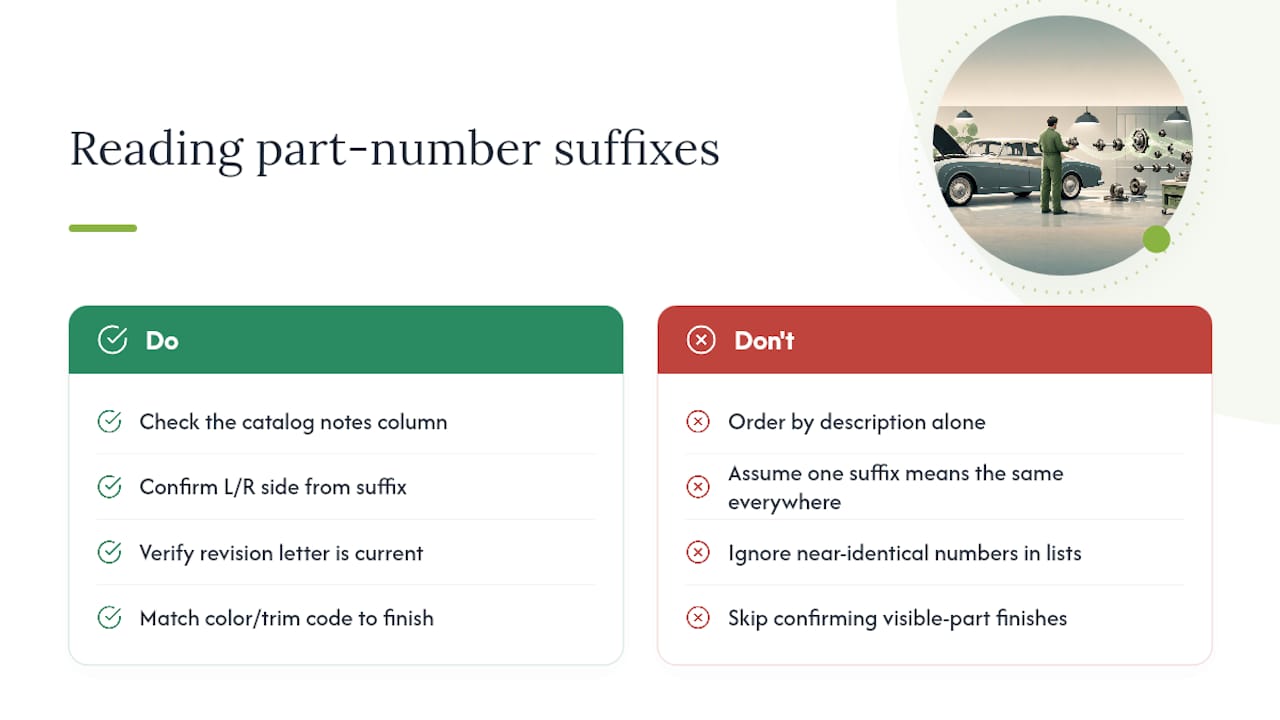
Prefixes and suffixes attached to a base Rolls-Royce OEM number typically encode information the base digits alone don’t capture, things like left versus right orientation, color or trim finish, or revision level. A suffix letter appended to an otherwise identical number often means “same part, different side” or “same part, updated material,” which is exactly the kind of detail that gets missed when someone orders by description alone.
Left/right suffixes are among the most common sources of ordering mistakes. A mirror housing, a door trim panel, or a suspension arm might share the same base number with only a single trailing letter distinguishing driver’s side from passenger’s side. If your catalog entry shows two nearly identical numbers sitting side by side in the parts list, that’s almost always what’s happening.
Revision suffixes work differently. When a supplier or manufacturer updates a part’s material, tolerance, or design slightly without changing its function, the base number often stays the same while a revision letter or digit changes. Catalog mirrors track this specifically so buyers know whether the number they’re holding is the current version or an earlier revision that’s still functionally compatible.
Color and trim codes show up as suffixes too, particularly on interior and exterior trim parts where the same physical component ships in a dozen different finishes. These codes matter enormously for visible parts and matter far less for anything hidden inside the mechanical structure of the car.
The safest approach is never to assume what a prefix or suffix means from pattern recognition alone. Check the catalog’s own notes column for that specific row, since the same suffix letter can mean something different in one assembly group than it does in another.
How to Identify Counterfeit or Incorrect Part Numbers
The first red flag is a part number that doesn’t match the digit-block pattern typical of the catalog entry for that assembly group. Genuine Rolls-Royce numbers follow a recognizable structure, and a listing showing a number that’s noticeably shorter, longer, or formatted differently than the surrounding rows in a legitimate catalog deserves a second look before you buy.
Packaging inconsistency is another practical signal, particularly for parts sold loose or reboxed by third-party sellers. A stamped or cast number on the physical component that doesn’t match the number printed on the box or listing is a direct contradiction worth resolving before payment, not after.
Pricing that sits dramatically below every other listing for the same OEM number is worth scrutinizing rather than celebrating. Genuine OEM parts for a Rolls-Royce carry real manufacturing and sourcing costs, and a price far outside that range on an identical part number usually means the part isn’t what the listing claims, or it’s a reboxed aftermarket equivalent sold under the wrong code.
The most reliable defense remains the physical check described earlier: match the stamped or cast number on the actual part against the catalog row before you install anything. A 7zap catalog reference or similar mirror gives you the number to check against, but the check itself has to happen with the part in hand, not just on a screen. If a seller can’t or won’t tell you where the part number is physically marked on the component, treat that as a reason to keep asking questions.
Cross-Referencing Rolls-Royce Part Numbers With Aftermarket Alternatives
Not every part on a Rolls-Royce needs to come from an OEM-numbered source, and cross-referencing against aftermarket alternatives is standard practice for consumables and shared mechanical components. Filters, belts, standard bearings, and certain seals often have direct aftermarket equivalents manufactured to the same specification, sometimes by the same supplier that produces the OEM version under a different label.
The cross-reference process starts with the OEM number you’ve already confirmed through the catalog, then checking specialist supplier databases or parts cross-reference tools that map that number against aftermarket part numbers from other manufacturers. Reputable aftermarket suppliers publish these cross-references openly, because the whole value of an aftermarket part is being provably equivalent to the original.
Where cross-referencing gets risky is on parts tied to fitment tolerances specific to Rolls-Royce, or on anything affecting structural or safety systems. A suspension bushing that’s “close enough” dimensionally can still ride differently or wear at a different rate than the original spec. For those components, sticking with the OEM number and a genuine or manufacturer-approved part is the safer call, even if an aftermarket equivalent exists on paper.
A good rule of thumb: cross-reference freely for wear items and consumables, verify carefully for anything mechanical, and default to OEM for anything you can’t easily inspect after installation.
Tips for Using Part Number Databases and Online Resources Effectively
Start every search with the most specific identifier you have, which usually means your VIN rather than your model name. A VIN-first search narrows the catalog to your exact generation before you’ve clicked a single diagram, which saves real time compared to browsing model-year listings and hoping you land on the right one.
Bookmark or save the specific catalog page once you find the right diagram, not just the search results. Some catalog mirrors regenerate session-based URLs, so a saved search that looked stable yesterday can dead-end today if the site doesn’t use permanent links for individual diagrams.
Cross-check any single database against at least one other source when the part in question is expensive or safety-relevant. Two independent catalogs agreeing on the same OEM number for your VIN is a stronger signal than one source alone, particularly when you’re dealing with a part that’s been superseded more than once.
Keep your own running record outside the database itself. Catalog sites occasionally restructure, migrate, or retire pages, and a personal log of confirmed OEM numbers, superseded numbers, and supplier responses survives that kind of change even when the original source doesn’t.
Finally, don’t treat a database’s absence of a listing as proof a part doesn’t exist. Older or low-volume parts sometimes aren’t digitized yet, particularly for classic models, which is exactly when a specialist supplier or printed schedule becomes more useful than any online catalog.
Practitioner Perspective: Why Verification Beats Blind Ordering
The restorers who avoid costly mistakes share one habit: they never trust a model name to tell them what part they need. Every experienced hand treats the catalog number as a starting hypothesis, not a conclusion, and confirms it against the physical part before spending a dollar. When a number looks ambiguous, or a supersession trail gets tangled, that’s the moment to call a parts specialist rather than guess and hope.
— Artem
Search by OEM Number or VIN on Supercars.parts
Some specialist marketplaces get you past the guesswork of scrolling through generic marketplace listings hoping one matches your Rolls-Royce. AI-driven search lets you enter an OEM number, a VIN, or even a photo of the stamped component, and matches that against large catalogs, which matters most when you’re chasing a superseded or low-volume part that a keyword search would never surface.
Once you’ve confirmed your part number through a catalog and cross-checked it against the physical component, bring that same information to a seller on the platform. Include your VIN, the OEM number, and the superseded number if one applies, and ask directly about fitment before you commit. Start your search now at Supercars and get a specific answer instead of another guess.
Sources
- Rolls-Royce Parts Catalog: OEM Numbers & Diagrams | 7zap
- Rolls-Royce parts catalogue | OEM — Catalogs Parts
FAQ
How Do I Find the Correct Part Number for My Rolls-Royce?
Enter your VIN into an ETK/RealOEM-style catalog mirror to select the exact generation, then locate the correct exploded diagram and cross-check the OEM number against the stamped marking on your actual component.
What Does It Mean When a Part Number Is Superseded?
A supersession means the original OEM number has been replaced by a newer part number, usually because of a material, design, or sourcing change; the catalog row typically shows both numbers together.
Are Aftermarket Parts Cross-Referenced to OEM Numbers Reliable?
Aftermarket cross-references work well for consumables like filters and belts, but structural or safety-related components are safer sourced against the original OEM number rather than a cross-referenced equivalent.
Can I Search for Rolls-Royce Parts Using Just a VIN?
Yes. Sites like Supercars.parts allow VIN-based and photo-based AI search, which helps match your exact build against listings without needing to already know the precise OEM number.
Why Do Some Catalogs Require an Account to See Part Numbers?
Certain commercial parts portals require account creation or VIN submission before revealing full parts lists, largely to confirm the parts shown actually apply to the specific vehicle being searched.


