Avoid Holds, Fees, and Damage: A Shipper Checklist for Car Parts
For most auto parts under 75 pounds, standard parcel shipping through UPS, FedEx, or USPS works fine. Anything heavier, palletized, or bulky needs LTL freight. Urgent or high-value components go air freight, and full engine swaps or bulk inventory moves call for a full truckload. The rule that overrides every other decision: drain all fluids and follow carrier hazmat policy before anything else, then immobilize the part, cushion it, and protect every exposed edge.
TL;DR:
- Shipping car parts over 75 pounds or bulky items requires freight methods like LTL, air freight, or full truckload, depending on weight and urgency.
- Proper packaging involves draining fluids, cushioning edges, and securing parts to prevent damage, with specific techniques for panels, glass, wheels, and engines.
- Hazmat restrictions mean all residual fluids must be drained and batteries properly documented, or shipments risk delays, fines, or confiscation.
- Accurate measurement, weight, and declaration of values are essential to avoid unexpected fees, delays, or denied claims during transport.
- International shipping demands precise customs documentation, correct HS codes, and declared values to prevent border delays and extra storage charges.
Table of Contents
- Choosing the Right Method for Shipping Car Parts
- How to Pack Common Car Parts, From Bolts to Blocks
- What Counts as Hazardous, and How Carriers Treat It
- Measuring and Weighing to Avoid Surprise Fees
- Building a Crate or Pallet That Survives the Trip
- Insurance, Declared Value, and Filing a Claim
- Shipping Car Parts Internationally Without Customs Delays
- Saving Money Without Cutting Corners on Protection
- How Supercars.parts Supports Safe Shipping of Rare Components
- A Compact Checklist and the Mistakes Nobody Warns You About
- Find and Ship Rare Parts Through One Marketplace
- Sources
Choosing the Right Method for Shipping Car Parts
The method you pick depends on three numbers: weight, dimensions, and how badly you need the part to arrive fast — for detailed guidance, see Buying a Car Out of State: Your Step-by-Step Checklist | Clearwater Largo Automotive. Get any of those wrong and you’ll either overpay or get your shipment bounced back by a carrier who won’t touch it.
Parcel carriers handle most brackets, sensors, small trim pieces, and electronics without complaint. The practical ceiling sits around 70 to 75 pounds and 108 inches in length for most residential-tier services, though commercial accounts sometimes push higher. Once you cross that threshold, or once a box’s combined length and girth balloons past carrier limits, you’re not shipping parcel anymore. You’re shipping freight, whether you meant to or not.
Less-than-truckload (LTL) freight is the right call for palletized wheel sets, crated body panels, transmissions, and anything over 150 pounds that doesn’t fill a whole trailer. LTL carriers price by freight class, a system the National Motor Freight Traffic Association maintains based on density, stowability, liability, and how much handling a shipment needs. A dense, well-packed pallet of forged wheels prices very differently than a bulky, awkward-shaped crated hood, even at similar weights.
Air freight earns its premium when a part is either urgent (a race car sidelined for a weekend) or genuinely valuable (a rare Ferrari gearbox worth more than most cars). Full truckload (FTL) makes sense when you’re moving a complete parts inventory, relocating a shop, or shipping enough volume that a dedicated trailer costs less per pound than stacking LTL shipments.
A few situations call for something more specialized than any standard carrier offers:
- Carbon fiber body panels or splitters that flex or crack under standard freight handling
- Concours-quality paint that can’t tolerate strap contact or shifting inside a crate
- Ultra-low ground clearance components that need lift-gate service and careful loading angles
- Matching-numbers engines or transmissions where provenance and condition documentation matter as much as the physical part
For those cases, white-glove or specialist automotive logistics providers cost more, but they build crates to the part instead of forcing the part into a generic box. That difference shows up in the claims data: parts shipped in fitted crates with corner blocking see dramatically fewer transit damage claims than the same parts stuffed into oversized cardboard with foam peanuts.
How to Pack Common Car Parts, From Bolts to Blocks
Packaging strategy changes completely depending on what you’re shipping. A sensor and a small-block V8 have nothing in common except that they both need to survive a truck ride.
Here’s how to approach the most common categories:
-
Small hardware and electronics. Bag sensors, ECUs, and circuit boards in anti-static packaging before anything else touches them. Wrap in bubble wrap, then use a snug corrugated box with void fill so nothing shifts. A part that rattles inside its box during a shake test will arrive damaged.
-
Body panels, bumpers, and hoods. Wrap the panel in foam sheeting, then wrap every edge and corner separately with foam corner protectors or heavy cardboard corner guards. For anything with finished paint, double-boxing (a snug inner box inside a larger outer box with rigid foam between them) prevents the single most common failure mode: a forklift tine or another package puncturing through to the paint.
-
Glass and mirrors. Maintain at least two inches of foam clearance on all sides. Large windshields and quarter glass need wooden crating, not cardboard, full stop. Label every face of the package “GLASS, FRAGILE” and add “THIS SIDE UP” arrows, because handlers can’t tell orientation once a crate is stacked.
-
Wheels and tires. Palletize full sets rather than shipping individually. Use wheel chocks or blocking lumber to stop rolling, and wrap chrome or polished rims in moisture-barrier plastic since condensation inside a trailer will pit finished aluminum.
-
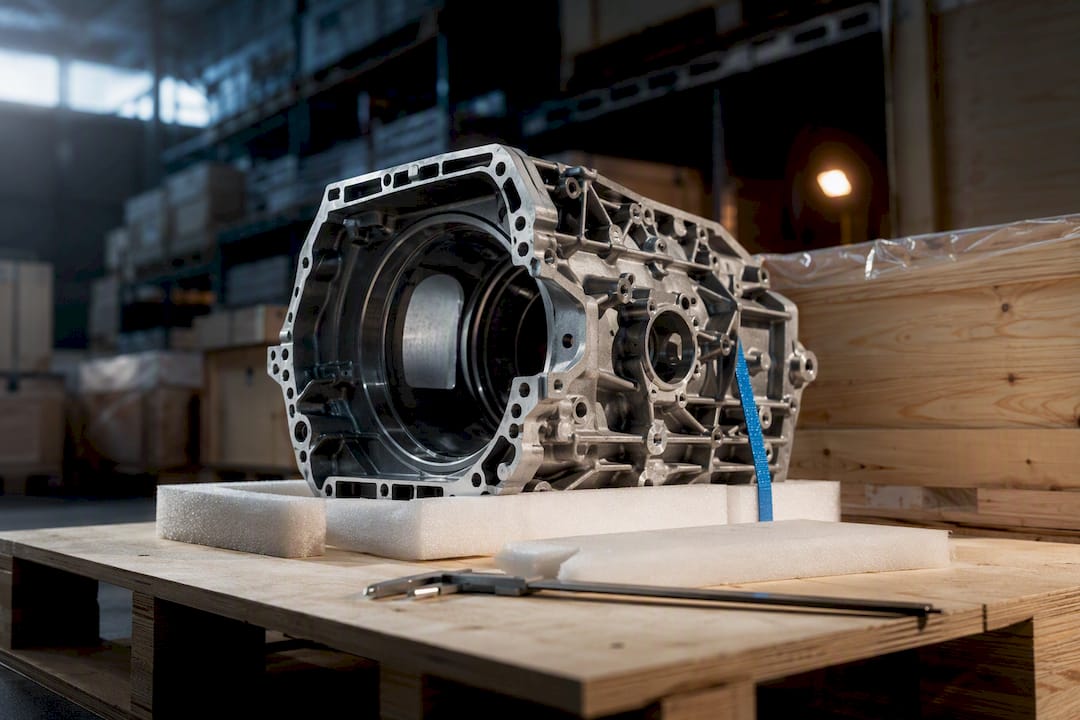
Engines and transmissions. Drain every fluid completely, including residual oil in the pan and coolant in the block. Cap and plug every open port (fuel lines, coolant fittings, the bell housing) to keep debris and moisture out of machined sealing surfaces. Crate the unit or band it securely to a pallet using ratchet straps rated for the weight, then photograph the part from multiple angles and log the serial number before it ever leaves your possession.
Pro Tip: Photograph the part sitting inside the finished package, not just the part alone. If a carrier disputes how something was packed after damage occurs, that photo is your evidence that you followed reasonable care standards.
Carrier guidance from Purolator reinforces the same core sequence across nearly every part category: drain it, cushion it, protect the edges, and label it clearly. Skip any one of those steps and you’re gambling on the part arriving in the condition it left.
What Counts as Hazardous, and How Carriers Treat It
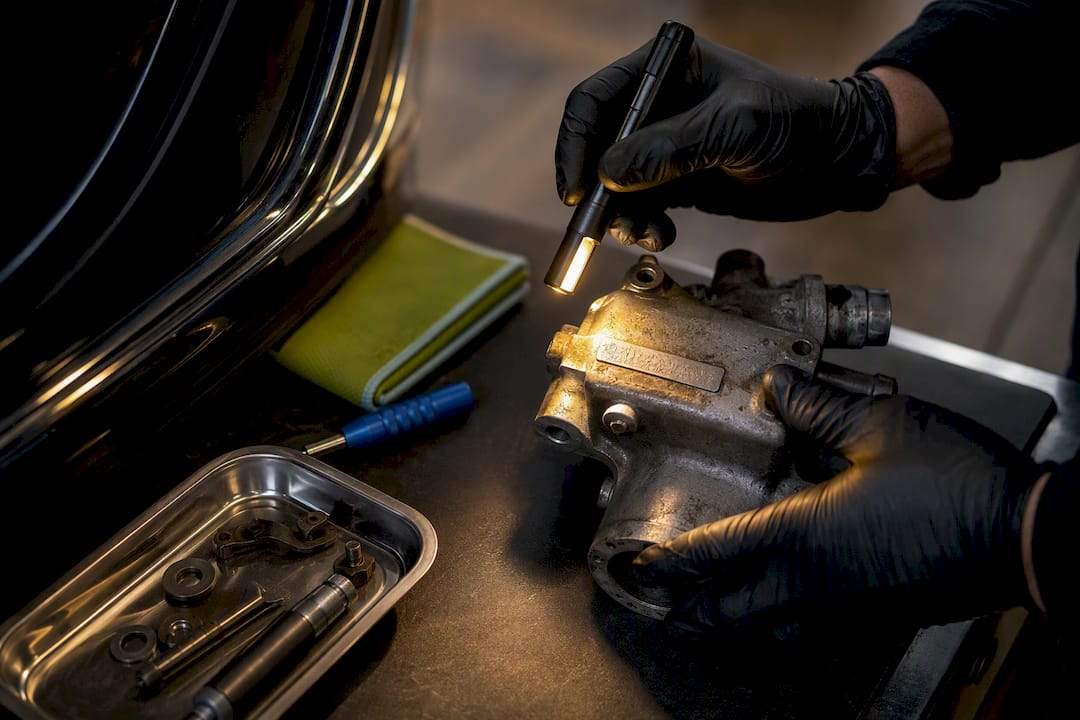
Residual fluids are the number one reason carriers refuse or delay automotive shipments. Even a small amount of gasoline, oil, or coolant left in a part can trigger hazmat protocols, and once that happens, your simple parcel shipment turns into a paperwork problem. The fix is straightforward: drain completely, wipe down with a degreaser, and let the part air out for 24 hours before boxing it. That airing period matters because trapped fumes inside a sealed box can still register on carrier hazmat screening.
Batteries follow their own rules, and lead-acid and lithium batteries are not interchangeable in how carriers treat them:
- Lead-acid batteries generally ship ground with proper orientation and terminal protection, but most carriers won’t accept them by air.
- Lithium batteries require documented state-of-charge, UN-rated packaging, and specific hazard labeling, and many services restrict or refuse them entirely depending on charge level.
- USPS bans most vehicle batteries outright, full stop, regardless of packaging.
- FedEx and UPS accept batteries conditionally, but only with correct hazmat documentation, proper labeling, and sometimes a signed shipper declaration.
Get this step wrong and you’re not looking at a delay. You’re looking at a fine, a seized shipment, or a carrier account flag that follows you into future bookings.
Measuring and Weighing to Avoid Surprise Fees
Dimensional weight is where a lot of shippers get burned on price after the fact. Carriers calculate billable weight by multiplying length by width by height and dividing by a divisor (commonly 139 for domestic U.S. parcel), then charging whichever number is higher: actual weight or dimensional weight. A lightweight but bulky bumper cover can easily bill heavier on paper than it does on a scale.
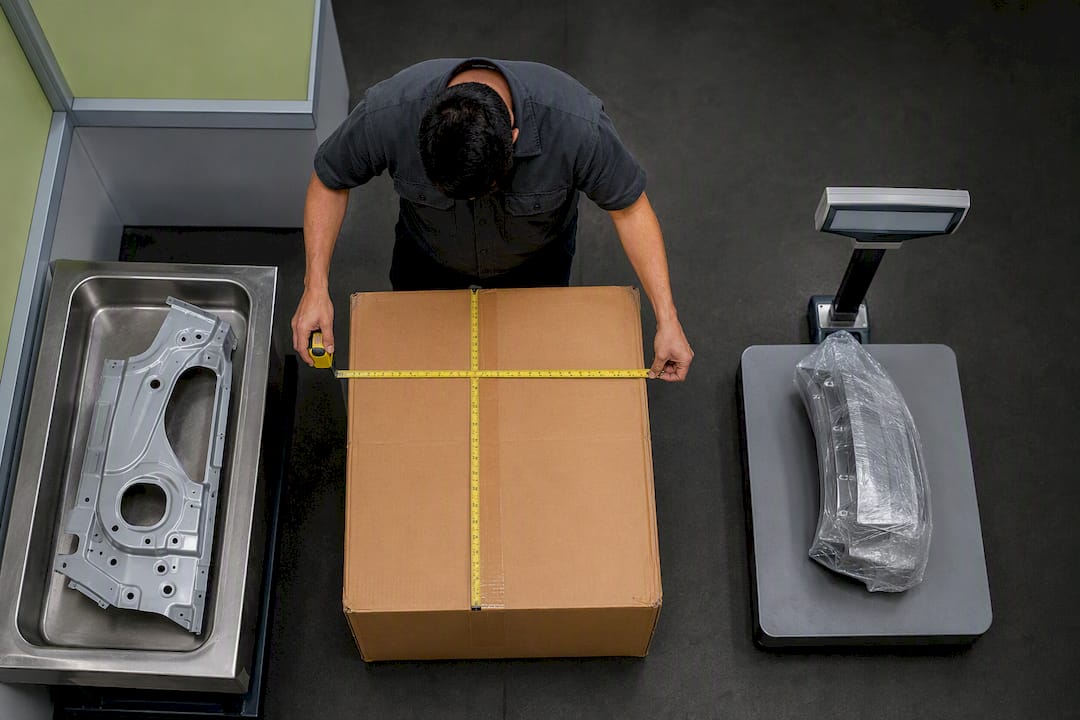
Measure length plus girth for anything approaching freight territory, since most carriers define an oversize or additional-handling surcharge threshold around 130 inches of length plus girth combined, and a hard oversize cutoff near 108 inches in length alone. FedEx’s automotive parts guidance walks through exactly where those thresholds sit for different part categories.
Three habits prevent almost every dimensional weight surprise:
- Measure the box after packing, not the part alone. Padding and crating add real inches.
- Weigh on a scale rated for the item’s actual weight range. A bathroom scale under-reports on heavy items.
- Enter dimensions into the carrier’s own booking tool before paying, since quoted rates can shift once the system recalculates against dimensional weight.
One extra inch of length or girth can bump a package into a different pricing tier entirely, so measuring twice before you book beats disputing a reweigh charge after the fact.
Building a Crate or Pallet That Survives the Trip
Crating and palletizing exist to solve one problem: stopping a heavy or oddly shaped part from moving during transit. Movement is what causes most freight damage, not impact.
Use these guidelines to decide which approach fits and how to execute it:
-
Decide crate versus pallet first. Palletize items with a stable base and predictable shape, like a boxed transmission or a stack of tires. Crate anything fragile, irregularly shaped, or valuable enough that exposure to forklift tines or stacking pressure is a real risk, such as a bare engine block or a finished body panel.
-
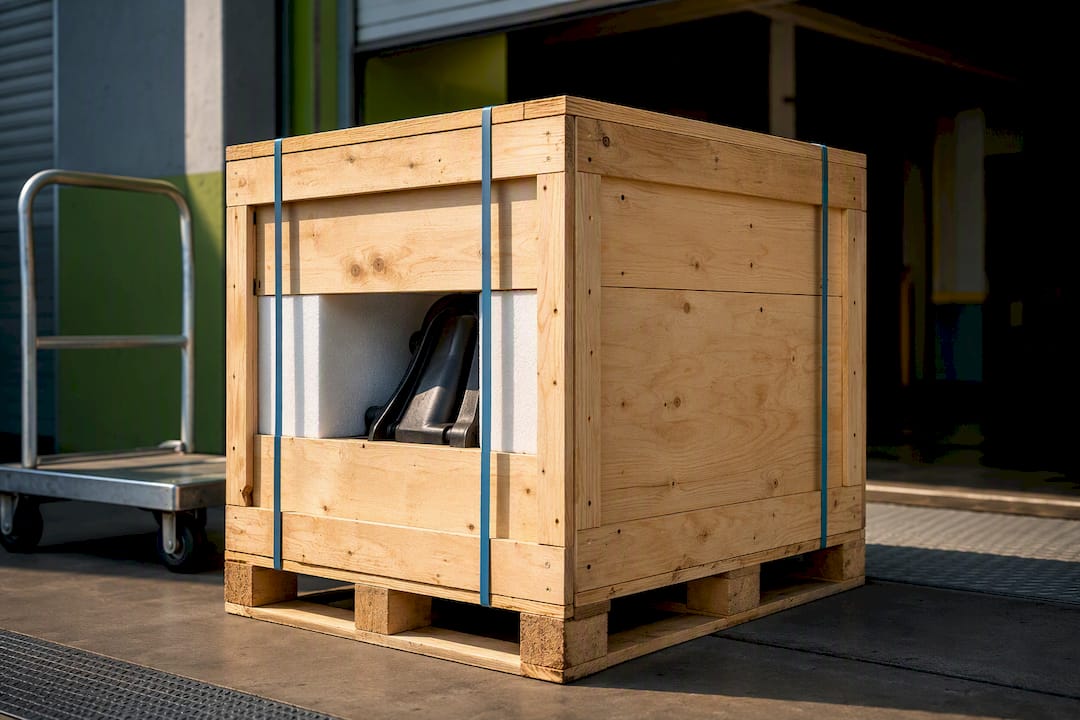
Build the crate to the part. A basic wood crate needs a solid base, corner posts, and cross-bracing sufficient to prevent racking (side-to-side flex) under normal handling. Line the interior with foam or corrugated padding wherever the part touches wood.
-
Band and block everything. Use ratchet straps or steel banding rated above the part’s weight, and add wood blocking or foam wedges so the item can’t shift laterally even if the straps loosen slightly in transit. This is sometimes called H-taping when applied to box seams, reinforcing both the main seam and the perpendicular seams in an H pattern for extra resistance to seam failure.
-
Label every face. Freight labels go on at least two sides, forklift-entry points get marked clearly, and orientation arrows go on all four vertical faces, not just one. Attach the bill of lading and any customs paperwork in a weatherproof pouch on the outside of the crate, never loose inside it.
Pro Tip: Take a photo of the finished, strapped crate from all four sides before the carrier picks it up. If a claim comes up later, that photo proves the securing method you used, not just the part’s condition.
Insurance, Declared Value, and Filing a Claim
Most carriers cap default liability far below what a car part is actually worth. Standard parcel carriers often limit coverage to somewhere in the range of $100, and LTL freight liability is calculated per pound of the shipment, which can leave a compact but expensive part badly under-covered. If what you’re shipping is worth more than the default limit, buy supplemental transit insurance, sometimes called shipper’s interest insurance, at booking.
Documentation is what separates a paid claim from a denied one. Before the carrier ever touches the box:
- Photograph the part from multiple angles, including any existing wear or damage
- Record serial numbers and part numbers where applicable
- Weigh and measure the finished package, and keep that data with your shipping receipt
- Save the carrier’s own condition acknowledgment at pickup if one is offered
If damage happens, most carriers require a claim filed within a set window, often 9 to 60 days depending on the service and whether the shipment was domestic or international. Submit photos of the damaged part still in its original packaging, the original condition photos, and the shipping receipt together. Claims missing pre-shipment documentation get denied far more often than claims with a clear before-and-after record.
Shipping Car Parts Internationally Without Customs Delays
Cross-border shipments live or die on paperwork accuracy. A commercial invoice, a packing list, and a bill of lading (or air waybill for air freight) form the baseline documentation for almost any international parts shipment. Certain items need more: a certificate of origin for preferential tariff treatment, or a CITES certificate if a part contains any regulated material, which occasionally applies to older vehicles with genuine ivory, tortoiseshell, or exotic leather trim.

The single biggest cause of customs holds isn’t missing paperwork. It’s vague or incorrect classification. CBP’s own guidance on cross-border e-commerce shipments emphasizes accurate documentation as the difference between smooth clearance and a shipment sitting in a bonded warehouse racking up storage fees. Getting the Harmonized System (HS) code exactly right matters more than most shippers realize, since research on automotive cargo classification shows that even small classification errors routinely trigger delays and extra storage charges.
A few practical habits reduce risk substantially:
- List each part separately on the commercial invoice with its own value and HS code, never as a bulk “auto parts” line item
- Declare the true transaction value, since undervaluing to save on duty is both illegal and a common trigger for customs inspection
- Consider DHL’s guidance on double-boxing and insured international shipping for anything valuable crossing a border
- Use a freight forwarder or a carrier offering end-to-end customs brokerage when shipping high-value or complex parts internationally, since they handle classification and clearance directly
Saving Money Without Cutting Corners on Protection
Cost control and careful packing aren’t in tension. The savings live in how you book, not in how much foam you skip.
Freight marketplaces work by filling unused capacity on trucks that are already running a route, which lets small shippers access volume-discounted LTL rates that would otherwise require a business account and regular shipping volume to unlock. For smaller parcel shipments, third-party discounted label platforms give access to commercial UPS and USPS rates that can run 10 to 60 percent below retail counter pricing, depending on service level and volume.
When does the math favor a specialist instead? A few clear signals:
- The part’s replacement value exceeds what standard carrier liability would cover even with supplemental insurance
- The part is irreplaceable, meaning provenance and originality matter as much as function
- Standard freight handling risk (forklifts, stacking, general cargo treatment) poses real damage risk to the finish or structure
How Supercars.parts Supports Safe Shipping of Rare Components
Sourcing a part is only half the problem when you’re dealing with a Ferrari, Lamborghini, or Aston Martin. Getting it home intact is the other half. Supercars.parts lists over 365,000 exotic and supercar parts, and the AI-driven search cuts the time buyers spend hunting down an exact fitment, but the platform’s real value for shipping shows up in how sellers document what they’re sending.
Rare parts need bespoke crating and, often, insurer coordination, not generic courier handling. That’s why sellers on the platform are encouraged to provide clear condition photos, an accurate declared value, and packaging details up front. Buyers should expect and request the same before committing: serial numbers, condition photos from multiple angles, and a stated recommendation on insurance coverage relative to the part’s actual value.
A Compact Checklist and the Mistakes Nobody Warns You About
Three mistakes show up constantly in shipping disputes that never had to happen. First, under-padding edges instead of surfaces. Most people cushion the flat faces of a part and skip the corners, but corners are where nearly all impact damage concentrates. Second, skipping the degrease-and-air step after draining fluids. A part can be fully drained and still carry enough residual odor or vapor to get flagged, delayed, or refused. Third, misdeclaring value to save a few dollars on insurance premiums, which guarantees a denied claim if something actually goes wrong.
Before anything leaves your hands: measure it, weigh it, drain it, degrease it, air it out, photograph it, cushion every edge, label every face, and confirm your declared value matches what you’d actually need to replace it. That sequence, followed in order, prevents the overwhelming majority of shipping failures this article has walked through.
— Artem
Find and Ship Rare Parts Through One Marketplace
Sourcing a hard-to-find McLaren clutch assembly or a discontinued Rolls-Royce trim piece usually means digging through scattered forums and small-time sellers with no standardized listing information. Supercars.parts solves the sourcing half of that problem with over 365,000 listings and an AI search tool that narrows results to your exact fitment in seconds instead of hours.
Once you’ve found the part, everything covered above, from draining fluids to declaring accurate value, applies directly to getting it to your door safely. Sellers on the platform list condition details and photos up front, which gives you the documentation you need before a part ever ships. If you’re restoring a rare exotic or sourcing parts for a client’s build, Supercars and start a conversation with a seller about condition, packaging, and shipping before you commit to a purchase.