Four Ferrari Wheel Fitment Specs Owners Must Verify
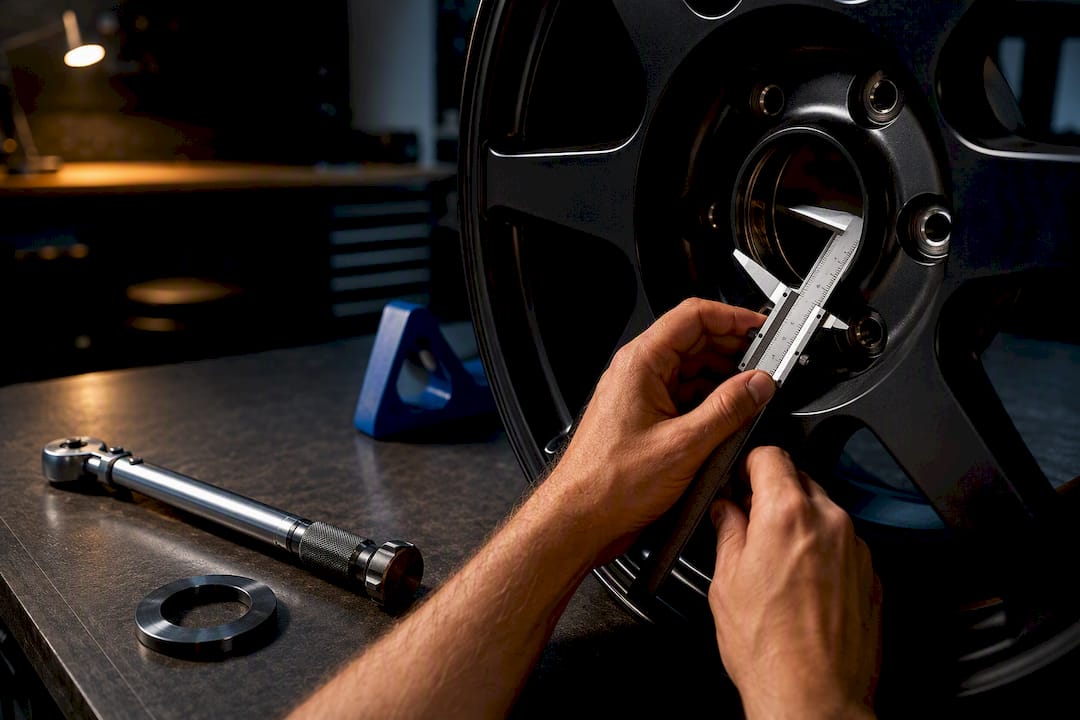
Ferrari wheel fitment comes down to four numbers: bolt pattern (PCD), center bore, offset (ET), and brake caliper clearance. Get any one of those wrong and a wheel that looks correct on paper will either not bolt on, rub the caliper, or sit at a stance that throws off steering geometry. Before ordering anything, confirm all four against your exact model, year, trim, and brake package in a reliable fitment database.
TL;DR:
- Always verify all four key measurements—bolt pattern, center bore, offset, and brake clearance—against your exact car build before purchasing wheels.
- Regional variations in Ferrari models mean that specifications like offset can differ by several millimeters even within the same model and year.
- Confirm fitment with a brake template to avoid caliper interference, especially since spoke curvature and backpad depth can cause issues despite correct PCD and offset.
- Use a detailed record of your exact car specs and fitment data to streamline future wheel replacements and prevent costly fitment errors.
- Reliable sources for verified wheels include marketplaces with AI-driven searches that filter results by your specific measurements and build details.
Table of Contents
- Where to Find Your Ferrari’s OEM Wheel Specifications
- What PCD, Center Bore, Offset, and Clearance Actually Mean
- What OEM Fitment Looks Like on the 458, 296, and SF90
- Your Step-by-Step Fitment Verification Checklist
- The Fitment Mistakes That Cost Owners the Most
- Why Verification Beats Guesswork Every Time
- Find Verified Wheels and Hardware Once You Know Your Specs
- Sources
Where to Find Your Ferrari’s OEM Wheel Specifications
Start with Wheel-Size’s Ferrari database, which breaks down rim diameter, width, offset, PCD, and center bore by model and year. Vendor guides from wheel manufacturers add a second layer of practical detail, since they’ve actually built wheels for these chassis and documented what fits versus what only looks like it should.
The catch with any database lookup is regional variation. Ferrari sells the same model with different suspension tunes, brake packages, and even wheel offsets depending on the sales market, so a spec pulled from the wrong region’s table can be off by several millimeters on offset alone. Always cross-check against your VIN or your exact build sheet rather than trusting the model name in isolation.
When you pull up a table, copy down these fields before you go shopping:
- Front and rear rim diameter and width (e.g., 20x9 front, 20x11 rear)
- OEM tire size for each axle
- Offset (ET) range, not just a single number
- PCD (bolt pattern) and lug/bolt type
- Center bore diameter in millimeters
Offset is often listed as a range rather than a fixed figure because brake package and trim variants shift the acceptable window. Treat the range as a starting point, not a final answer.
What PCD, Center Bore, Offset, and Clearance Actually Mean
Each of the four core measurements plays a different role, and understanding what each one controls saves you from a wheel that “fits” the bolt pattern but fails everywhere else.
- PCD (bolt pattern) describes the diameter of the circle formed by your lug bolts and how many there are. Most modern Ferraris use a 5x114.3 pattern, but the bolt type (stud versus bolt, thread pitch) still needs matching, since a correct PCD with the wrong fastener will not seat properly.
- Center bore is the hole in the middle of the wheel that centers it on the hub. Ferrari hubs commonly measure around 67.1 mm, and an aftermarket wheel with a larger bore needs hub-centric rings to take up the gap. A bore that’s too small simply won’t slide onto the hub at all, and a loose hub-centric fit causes vibration no amount of balancing will fix.
- Offset (ET) determines how far the wheel’s mounting face sits from its centerline, which pushes the tire in or out relative to the fender and suspension components. Widening a wheel without adjusting offset changes how much tire pokes past the bodywork or crowds the strut.
- Brake clearance depends on spoke count, spoke curvature, and backpad depth relative to your caliper. A wheel with the right PCD and offset can still collide with the caliper if the spokes curve the wrong way near the rim’s inner lip.
Pro Tip: Ask any wheel vendor for a 3D brake template before you commit to a design. Specialized builders lean on these templates precisely because caliper interference is the single most common reason a “correct fitment” wheel gets sent back.
What OEM Fitment Looks Like on the 458, 296, and SF90
Numbers on paper turn into something you can actually check against your own car once you see them applied to specific models.
- Ferrari 458 Italia: A common performance fitment is 20x9 ET32 front and 20x11 ET43 rear, a pairing repeated across both wheel manufacturer and vendor fitment guides. Apex specifically flags that aftermarket lug bolts are often required here, since OEM lug seat length can conflict with a forged wheel’s backpad design.
- Ferrari 296 GTB: OEM tires run 245/35ZR20 up front and 305/35ZR20 in the rear, with OEM rims at roughly 9Jx20 ET44.7 front and 11Jx20 ET38.5 rear. Wheel-Size’s 296 GTB data puts offset in the ET38 to ET45 range depending on width, so don’t assume a single ET applies across every trim.
- SF90: Diameters and offsets are similar to the 296 platform, but the SF90’s hybrid drivetrain and high-performance brake packages can change caliper geometry. This makes a brake template check important beyond just relying on offset numbers.
Every one of these figures shifts with model year, trim level, and factory brake option, so treat them as a reference point rather than a final purchase decision. The only way to know your car’s exact numbers is to verify them against your own build.
Your Step-by-Step Fitment Verification Checklist
A methodical check before ordering costs you twenty minutes. Skipping it can cost you a wheel set that never gets mounted.
- Record your VIN, model, year, trim, and brake package. This is the anchor for every other lookup.
- Confirm PCD, center bore, offset, and rim width against a database entry that matches your exact build, not just your model name.
- Request the vendor’s brake template and check it against spoke and backpad clearance for your caliper.
- Verify load rating and fastener seat length so the wheel and hardware match your car’s actual weight and lug design.
- Plan for hub-centric rings or machining if the wheel’s bore is larger than your hub.
- Torque to spec and road-test at low speed before pushing the car hard, checking for rubbing at full steering lock.
When a vendor’s spec sheet lists an offset range rather than one number, lean on their brake template and fitment record rather than picking blind. Custom forged wheel builders run load-case validation covering radial, torque, and cornering loads, targeting a specific load reserve per wheel, so ask for that validation data if you’re running track duty or aggressive tires. Manufacturing tolerances and brake variants alone can shift a required offset by several millimeters, which is reason enough to confirm ride height and fender clearance on the actual car before production runs.
The Fitment Mistakes That Cost Owners the Most
Most fitment failures trace back to the same handful of shortcuts, and they’re avoidable once you know what to check.
- Ordering by model name alone, without confirming brake package and model year first.
- Assuming a matching bolt pattern guarantees full fitment, when spoke curvature or backpad depth can still hit the caliper.
- Skipping the tire model check. Two tires with the same printed size can have different shoulder profiles that change fender and steering clearance.
- Failing to keep a written fitment record for future replacements, forcing you to re-verify everything from scratch next time.
Pro Tip: Keep a single document with your PCD, center bore, ET, tire pairing, and torque spec. Update it every time you change wheels, and you’ll never have to redo this research from zero. And once new wheels are mounted, staying on top of brake dust buildup protects both the finish and your ability to spot caliper rub early. Removing brake dust promptly also makes it easier to visually check for witness marks that signal clearance problems.
Why Verification Beats Guesswork Every Time
The temptation with Ferrari wheel fitment is to trust the model name and move on. It doesn’t hold up. Two 458s with different brake options can need different offset ranges, and a 296 GTB built for one market can carry a slightly different OEM rim spec than the same car sold elsewhere. The databases and vendor guides get you close, but they can’t account for what your specific car looks like underneath the fender.
The mistake I see most often isn’t a bad measurement. It’s skipping the brake template step because the PCD and center bore already checked out. Those two numbers get a wheel onto the hub. They say nothing about whether the spokes will clear the caliper at full lock. Treat the four core measurements as a starting filter, not a finish line, and you’ll avoid the return shipments that come from an otherwise “correct” wheel.
— Artem
Find Verified Wheels and Hardware Once You Know Your Specs
Once you’ve confirmed PCD, center bore, offset, and brake clearance for your exact model and year, the harder part is often just finding a wheel or hub ring that actually matches those numbers. There are marketplaces specializing in exotic and supercar parts with AI-driven search features that let you narrow results by the specific figures you just verified instead of scrolling through generic wheel catalogs.
Before you search, have your model, year, VIN, PCD, center bore, offset, tire size, and brake package written down. Feed those specs into the Supercars and filter listings against them directly, which cuts down the back and forth of asking sellers to confirm compatibility one at a time. If you’re sourcing hub rings, aftermarket lug hardware, or OEM-spec wheels for a 458, 296, or SF90, start your search on Supercars with those numbers in hand.