Get Paid in 1–3 Days: Sell Your Exotic Car Online with Provenance

For most sellers who want speed with fair value, a dealer-backed cash sale or a concierge consignment network beats a solo private listing. Expect funds within 1 to 3 business days after inspection through those channels. Choose consignment or a private broker instead if discretion matters more than a quick close.
TL;DR:
- Dealer-backed cash sales typically close within 1 to 3 business days, providing faster funding compared to private listings or consignment.
- Preparing detailed photos, complete service records, and documentation like build sheets and provenance can significantly increase the sale price of a rare exotic car.
- When accepting offers, setting a clear reserve price beforehand helps avoid negotiations that could extend closing time or reduce profit.
- Wire transfers are the standard payment method, and securing written transport and lien payoff quotes in advance prevents last-minute deal breakdowns.
- Listing on specialized platforms like Supercars.parts, which verify parts and provenance, improves the chances of connecting with serious buyers interested in originality.
Table of Contents
- How Do You Choose Between Cash Buyers, Consignment, and Private Listings?
- How Do You Prepare an Exotic Car and Its Paperwork for Sale?
- What Makes a Listing Attract Serious Buyers Instead of Tire-Kickers?
- How Does an Online Appraisal Actually Value Your Car?
- What Happens During Inspection, Payment, and Title Transfer?
- How Does Supercars.parts Support Sellers Beyond the Car Itself?
- The Checklist I’d Follow If I Were Selling Tomorrow
- Ready to List? Here’s Where Supercars.parts Fits In
- Sources
How Do You Choose Between Cash Buyers, Consignment, and Private Listings?
Every exotic car sale runs through one of three lanes, and picking the wrong one costs either time or money.
Cash buyer / dealer-backed platforms move fastest. You submit VIN, photos, and condition details, get a written offer, and close in days rather than weeks. Many dedicated exotic-car buyers extend offers within minutes to two days, with funds landing shortly after a physical inspection confirms the car matches the listing. This route suits owners who want certainty over top dollar.
Consignment and broker networks trade some speed for reach. A broker markets your car to a curated buyer list, sometimes tapping databases of hundreds of dealers and collectors, and negotiates on your behalf. You’ll wait longer for a match, but rare or low-production models often land a better number this way.
Private listings put you in full control of pricing and buyer conversations, but you absorb the marketing work, the screening, and the risk of a deal falling apart at the last minute.
The decision comes down to priority:
- Need cash fast? A dealer-backed buyer is the shortest path from offer to wire transfer.
- Chasing the highest number? Consignment or a broker network with access to serious collectors usually wins.
- Want to stay off public radar? Private broker channels keep your sale out of searchable listings entirely.
- Have a common model in good condition? Cash buyers process these efficiently since valuation is straightforward.
How Do You Prepare an Exotic Car and Its Paperwork for Sale?
Buyers pay for confidence as much as they pay for horsepower. A spotless car with a thin paper trail still gets discounted, while a well-documented car in good but not perfect condition often out-earns it.
Work through these steps in order:
- Detail the car properly. Paint correction, engine bay cleaning, and fresh photos of wheels and interior stitching matter more for exotics than for ordinary used cars, since buyers zoom in on details a standard trade-in never gets scrutinized for.
- Gather every document. Title, complete service history, original build sheet or window sticker, and any factory option documentation. Provenance paperwork, prior owner history, race or show history if applicable, tends to move the number more than a fresh detail job does.
- Handle small mechanical items before listing. Fluid leaks, worn tires, or a check engine light get flagged during inspection and give buyers leverage to renegotiate after you’ve already committed emotionally to the deal.
- Confirm your loan or lease payoff amount in writing. If the car is financed, ask any platform you’re considering how they manage lien payoffs, because a seller stuck coordinating with a lienholder mid-sale is the single most common reason closings stall.
Pro Tip: Request your lender’s exact payoff quote and its expiration date before you accept any offer. Payoff figures often expire in 10 to 15 days, and a stale number can blow up a closing that was otherwise ready to fund.
What Makes a Listing Attract Serious Buyers Instead of Tire-Kickers?
Photos and copy do the pre-qualifying for you. A weak listing invites lowball offers and endless questions; a thorough one filters those out before they ever reach your inbox.
Shoot these angles at minimum:
- Front and rear three-quarter shots in daylight, no garage shadows
- Close-ups of wheels, tires, and brake calipers
- Full interior, dashboard, and seat condition from multiple angles
- Engine bay, VIN plate, and any option/build stickers
- Scans of the title, service records, and build sheet
For copy, lead with what actually separates one exotic from another: matching numbers, low mileage relative to the model year, rare factory options, and a documented service record. Professional listings that include build sheets, verified history, and sharp photography consistently pull stronger offers on rare variants, because buyers shopping at this level are comparing your car against three or four others they’ve already researched.
Where you list matters almost as much as how. Specialist exotic-car marketplaces reach buyers who already know what a build sheet is worth. Dealer networks add credibility and handle inquiries for you. Private forums and owner-club channels reach the most knowledgeable buyers but require you to screen out casual browsers yourself. For general listing hygiene, from photo staging to writing accurate condition disclosures, CarPulse’s guide to listing cars online covers practices that translate directly to the exotic segment.
How Does an Online Appraisal Actually Value Your Car?
Every serious appraisal runs on the same core inputs: VIN, exact trim and options, condition details, service records, and recent comparable sales. Buyers weigh those against live market data to land on a number, which is why two identical-looking cars can appraise thousands apart if one has a thin service file.
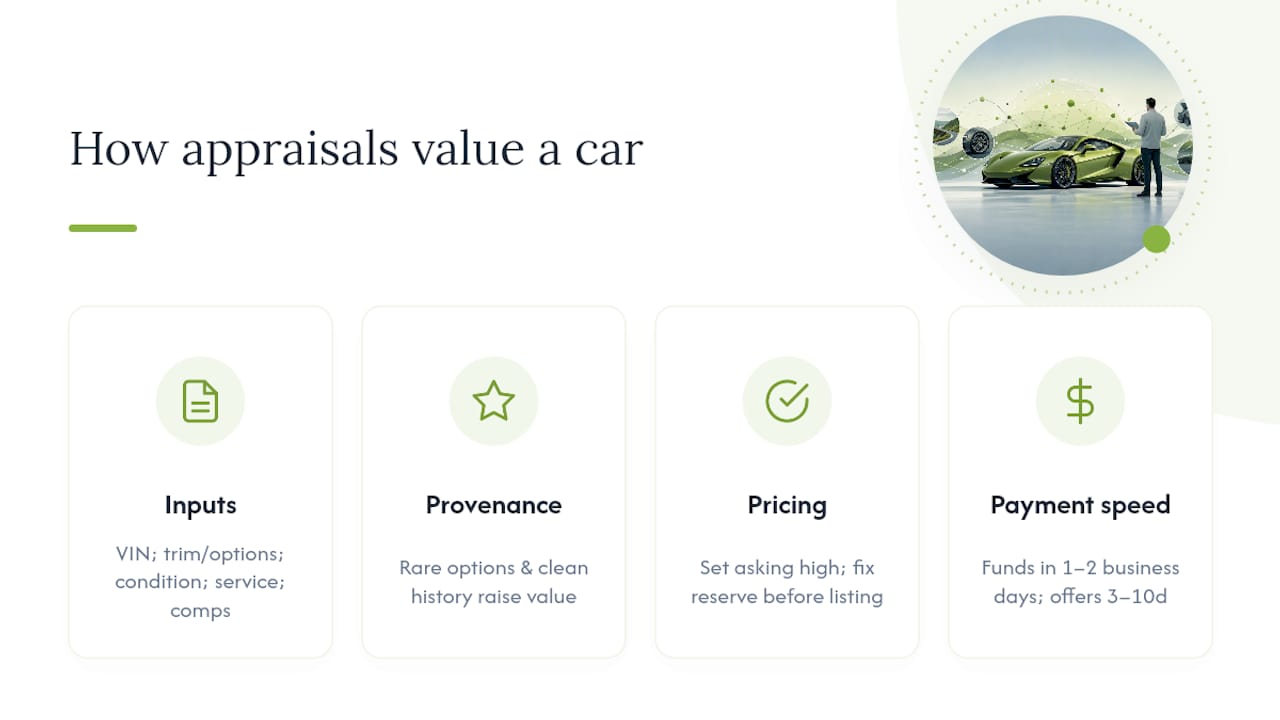
Bespoke factory options and clean provenance create the real premiums. A rare paint-to-sample color, a manual gearbox on a model mostly sold with automatics, or documented ownership by a known collector can each push a valuation well above the “generic” version of that same car. Buyers pay for the story, not just the spec sheet.
On pricing tactics: set an asking price with room to negotiate, but decide your reserve, the number below which you walk, before you list, not during a phone call with a buyer pushing for a discount.
Payment speed matters as much as the number itself. Sellers using dedicated exotic-car buyer platforms typically see funds within 1 to 2 business days of a completed inspection, with offers often staying valid for 3 to 10 days depending on the provider.
If a cash offer lands within your reserve and closes in days rather than weeks, that speed has real value. A slightly higher offer that takes another month to materialize isn’t automatically the better deal once you account for insurance, storage, and depreciation risk during the wait.
What Happens During Inspection, Payment, and Title Transfer?
Once you accept an offer, the process narrows to a few concrete steps, and each one has a right way to handle it.
- Inspection: a third-party inspector or the buyer’s representative checks the car against your listing. Have service records and any recent repair receipts ready to support what you’ve claimed.
- Payment: wire transfer is the standard for high-value transactions. Confirm the buyer’s payment method and timing before the inspection, not after, so there’s no ambiguity once the car passes.
- Timing: expect funds within a few business days of a clean inspection through most dealer-backed or concierge buyers, matching the timeline sellers report through platforms like Hypercars.
- Title and lien payoff: if you’re financed, the buyer’s platform should coordinate directly with your lienholder to release the title once funds clear.
- Shipping: insist on enclosed, insured transport, and get the transport quote locked in before the buyer takes delivery, especially for cross-country or international moves where costs swing widely.
Pro Tip: Get your enclosed transport quote in writing before finalizing the sale price. Unexpected shipping costs that surface after a deal is agreed are one of the most common reasons a closing collapses at the last minute.
How Does Supercars.parts Support Sellers Beyond the Car Itself?
Selling an exotic often means proving the car is exactly what you say it is, right down to the components under the hood. Supercars.parts maintains a marketplace of over 365,000 listings covering OEM and aftermarket components for Ferrari, Lamborghini, McLaren, Aston Martin, Rolls-Royce, and other marques, which gives sellers a direct way to document originality when a buyer questions whether a part is factory or replacement.
The platform’s AI-driven search helps identify and verify specific components fast, useful when a buyer’s inspector asks about a part number you can’t immediately place. Specialist marketplaces built around parts provenance also give buyers more confidence evaluating restoration scope and originality, since a documented parts history reads very differently than a seller’s word alone.
For sellers, this translates into:
- A reference point for confirming OEM part numbers tied to your VIN before listing
- A way to source and document replacement parts if a pre-sale inspection flags anything
- Access to a buyer base that already understands what “matching numbers” and factory-correct components are worth
The Checklist I’d Follow If I Were Selling Tomorrow
The mistakes that cost sellers real money are almost always the same: missing service records, phone-quality photos, picking a private listing when speed was the actual priority, ignoring a lien until it blocks closing, or accepting the first offer without a reserve in mind.
Work the process in this order: prep and detail the car, assemble every document, get a real appraisal, list with sharp photos and honest copy, screen buyers before you negotiate, then close with a verified payment method and locked-in transport. Skip a step and it usually shows up as a lower offer or a stalled closing later.
— Artem
Ready to List? Here’s Where Supercars.parts Fits In
Cash buyers move fast but rarely dig into build sheets. Broker networks reach serious collectors but take weeks. Supercars.parts gives you a third option: a specialist marketplace built around the exact details exotic buyers care about, verified parts, documented provenance, and a catalog of 365,000-plus listings that shows buyers you’re serious about originality.
When you list a vehicle or its components through Supercars.parts, the AI-driven search helps match your listing with buyers already looking for that specific make, model, or part, cutting down the back-and-forth that eats up weeks on general marketplaces. You get a listing environment where matching numbers and factory options actually register with the audience seeing them. Start your listing today at Supercars and see how your car or parts inventory shows up to buyers who already know what they’re looking at.