365,000 Listings: VIN to Part Number Search for Exotic OEM Fits
Yes, on any vehicle built in 1981 or later, the VIN decodes to the factory build sheet, and that build sheet is what lets you read exact OEM part numbers. The fastest reliable path is pasting the VIN into a trusted VIN-to-parts tool or the manufacturer’s own Electronic Parts Catalog (EPC), then confirming the number against the exploded diagram before you order anything.
TL;DR:
- VIN decoding reliably provides exact OEM part numbers for vehicles built in 1981 or later, based on detailed build data from the VIN structure.
- Proper validation of the VIN’s check digit and accurate transcription are essential to prevent order errors and mismatched parts.
- Cross-referencing build dates and factory-specific variations is crucial, as mid-year changes and plant differences frequently alter available parts.
- Marketplace AI tools speed up sourcing for rare, low-production, or exotic vehicles by consolidating listings and linking VIN data to verified OEM and aftermarket parts.
- Routine parts are generally straightforward to source via VIN decoding, but complex or limited-run models may require direct confirmation with a dealer or specialist.
Table of Contents
- How VIN Decoding Turns Into a Part Number
- From VIN to Orderable Part Number: A Step-by-Step Workflow
- Why VIN Lookups Still Fail: Pitfalls and Fixes
- Your Pre-Order Checklist
- How Supercars.parts Speeds Up VIN-to-Part Lookups for Exotics
- When to Trust the Decoder and When to Call a Human
- Get Your OEM Part Number Now
- Sources
- FAQ
How VIN Decoding Turns Into a Part Number
A VIN isn’t a random string. Every position carries a specific piece of information, and once you know what each block means, you understand why a decoder can hand you a real part number instead of a guess.
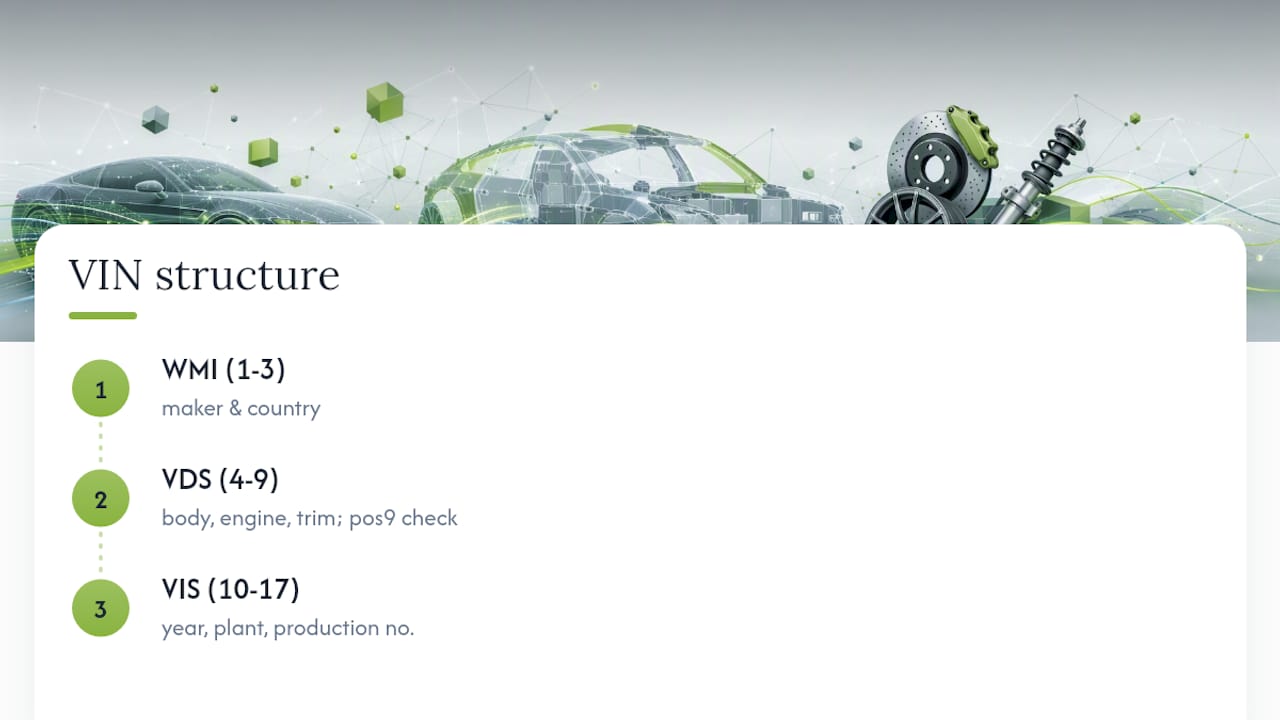
The first three characters are the World Manufacturer Identifier (WMI), which name the maker and country of origin. Positions four through nine make up the Vehicle Descriptor Section (VDS), which encodes body style, engine, and often trim level. The last eight digits, positions ten through seventeen, are the Vehicle Identifier Section (VIS), covering model year, assembly plant, and a sequential production number. This structure has been standardized since 1981 under NHTSA’s VIN decoding framework, which is why decoders can pull consistent engine, trim, and build-date data from any VIN built after that year.
That build data does the real work. Once a decoder knows your engine code, transmission type, drivetrain, and factory options, it can filter an OEM parts catalog down to only the components that match your specific build, not just your model. A VIN decoder tied to an OEM parts catalog will surface an exploded diagram of the exact assembly, with part numbers labeled on each piece. That diagram, not the model name on the badge, is the real source of truth.
Before any of that matters, the VIN itself needs to check out. Position nine in a standard 17-digit VIN is a check digit calculated under ISO 3779, and it exists specifically to catch a mistyped or fraudulent VIN before it feeds you wrong data. Skip that validation and you risk building an entire parts order on a typo.
From VIN to Orderable Part Number: A Step-by-Step Workflow
Getting from a 17-character code to a part sitting in your cart takes five steps, and skipping any one of them is where most wrong-part orders start.
- Find the VIN and copy it exactly. The most reliable spot is the driver’s-side door jamb sticker, followed by the lower corner of the windshield on the driver’s side, and your registration or title documents. One misread character (0 versus O, 1 versus I) sends you down the wrong catalog entry entirely.
- Run it through a VIN decoder or fitment engine. Read the output carefully: engine displacement and code, transmission type, drive configuration, trim package, and build date. Consumer-facing tools like O’Reilly’s VIN lookup show how mainstream parts retailers use this exact filtering logic to narrow catalog results to your build.
- Open the OEM exploded diagram the decoder points to. This is where you actually see the part number, usually listed next to a labeled component in an assembly view rather than buried in a spec sheet.
- Check for supersessions and aftermarket equivalents. Note any application flags tied to build date, plant code, or mid-year running changes. A part that fits a car built in March may not fit one from the same model year built in October.
- Confirm high-value or rare parts with a dealer parts desk or specialist before ordering. For anything expensive or hard to source, a five-minute phone call is cheap insurance against a return.
Each step matters because errors compound. Miscopy the VIN in step one, and every downstream step is built on bad data. Skip step four, and you might order a part that was correct for early production but got revised for a mid-cycle update.
Why VIN Lookups Still Fail: Pitfalls and Fixes
Trim and option packages change part numbers even inside the same model year, which trips up more people than any other single issue. Two cars with identical model-year badges can carry different brake calipers, different wiring harnesses, or different trim clips depending on which options box got checked at the factory.
Watch for these failure points before you commit to an order:
- Mid-year production changes. Manufacturers revise parts mid-cycle without changing the model year, and the build date buried in your VIN’s VIS section is often the only clue.
- Plant-specific variations. The same model assembled at two different plants can use different suppliers for interior trim or electrical components.
- Obsolete OEM numbers. Supersession chains exist because manufacturers redesign parts over time; the number stamped on your old part may have been formally replaced, and professional fitment tools that track supersession chains exist specifically to catch this.
- No-match results. Pre-1981 VINs don’t follow the standardized 17-character format, and modified, swapped, or poorly documented VINs on rare marques can return nothing at all.
When a decoder comes back empty, don’t assume the part doesn’t exist. It usually means the decoder’s catalog has a gap, not that the vehicle is undocumented, and the next move is a curated EPC or a specialist who works with that specific marque.
Pro Tip: Always cross-reference the build date buried in VIN positions 10 through 17 against the part’s application notes. A part number that looks right for your model year can still be wrong if your car was built before or after a documented running change.
Your Pre-Order Checklist
Run through this before you call a parts desk or click “buy”:
- Validate the VIN’s check digit and copy it character by character, with no guessing on ambiguous letters or numbers.
- Record the engine code, transmission code, and every optional-equipment code the decoder returns.
- Write down the OEM part number exactly as shown on the exploded diagram, along with any supersession note attached to it.
- Confirm fit verbally with the supplier or dealer, and make sure the OEM number, not just the description, is what’s logged on your order.
That last step matters more than it sounds. A supplier who confirms “brake caliper, front left” without checking the OEM number against your specific VIN is guessing just as much as you would be. Since 1981, the standardized VIN structure has made this level of precision possible for nearly every vehicle on the road, which is exactly why decoders can reliably pull engine and trim data that a plain model description never could.
How Supercars.parts Speeds Up VIN-to-Part Lookups for Exotics
Exotic and low-production vehicles are where generic VIN decoders struggle most, since thin catalog coverage on niche marques means a lot of tools simply return nothing useful. A marketplace built an AI-driven search specifically to close that gap, mapping decoded VIN data against a curated inventory of more than 365,000 listings spanning brands like Ferrari, Lamborghini, McLaren, Aston Martin, and Rolls-Royce.
Marketplace depth matters more on rare cars than common ones. A mainstream sedan might have a dozen parts suppliers stocking the same OEM number; a limited-run supercar might have three sellers worldwide, and finding them manually can take days. Marketplace depth and AI-assisted search shorten that search considerably by surfacing OEM and aftermarket listings tied to your decoded build in one pass instead of a dozen scattered searches.
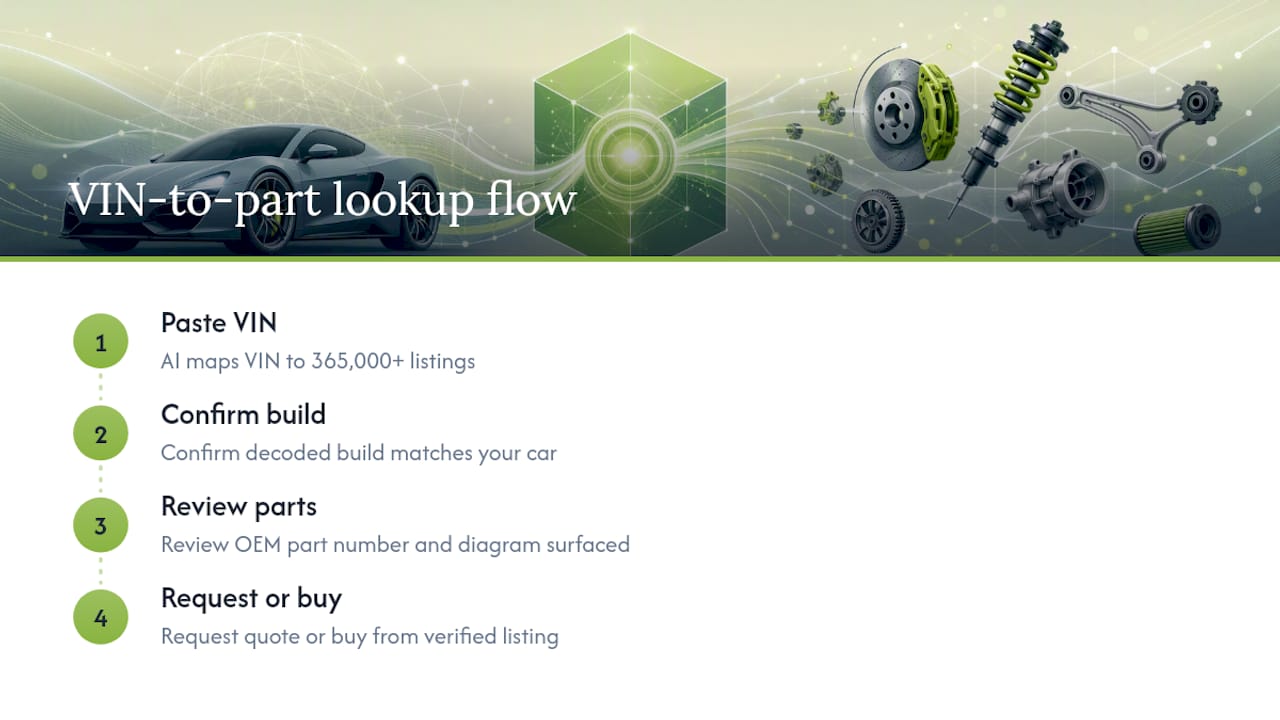
The practical flow looks like this: paste your VIN, confirm the decoded build details match your car, review the OEM part number and diagram the platform surfaces, then request a quote or buy directly from a verified listing on such a marketplace. For restorers working on cars where a single wrong bolt can mean a multi-week wait for a replacement, that shortcut has real value.
When to Trust the Decoder and When to Call a Human
VIN lookups handle routine parts on common models reliably almost every time. Trust them for brake pads, filters, and standard trim pieces on production cars with solid catalog coverage.
Escalate to a dealer or marque specialist when you’re dealing with a rare OEM revision, a limited production run, or a car that’s been modified enough that its build sheet no longer tells the full story. For anything expensive, a five-minute confirmation call against the actual EPC entry costs far less than a wrong part shipped across the country and sent back.
— Artem
Get Your OEM Part Number Now
A marketplace can turn the workflow described above into a single search box instead of five separate steps across five different sites. Paste your VIN, let the AI search cross-reference it against a marketplace of over 365,000 listings for Ferrari, Lamborghini, McLaren, Aston Martin, Rolls-Royce, and other exotic marques, and see OEM and verified aftermarket options in one pass, without hunting through a dozen forums for a part a mainstream catalog never carried.
That’s the real advantage over sifting through scattered listings one seller at a time: one search, one curated inventory built specifically for cars where parts sourcing usually means weeks of phone calls. If your VIN comes back with no clear match, or you’re chasing a part for a low-production model, Supercars and request sourcing help directly. Paste your VIN today and see what the AI search turns up before you spend another afternoon cold-calling parts desks.
Sources
For the official VIN structure, see the NHTSA VIN decoder. For catalog-level OEM diagrams, see VINsearch’s aggregated EPC access.
FAQ
How Can I Find a Part Number Using My VIN?
Run the VIN through a VIN decoder or an OEM Electronic Parts Catalog, then open the exploded diagram for the assembly you need. The part number listed there is tied specifically to your car’s decoded build, not just its model name.
Can I Use the VIN Number to Find Parts?
Yes, for any vehicle built in 1981 or later, since the standardized 17-character VIN encodes engine, trim, and build-date data that parts catalogs use to filter results to your exact configuration.
Can I Order Parts by VIN Number?
Yes. Most dealer parts desks and marketplaces like Supercars.parts let you enter a VIN, confirm the decoded build, and order the OEM part number directly, which is generally faster and more accurate than searching by model name alone.
How Do I Check Car Parts With a VIN?
Decode the VIN first to confirm engine, trim, and option codes, then cross-reference those details against the OEM exploded diagram and any supersession notes before finalizing an order.
What if My VIN Returns No Match in a Decoder?
This usually means a pre-1981 format, a modified or replaced VIN, or a gap in that decoder’s catalog coverage, not that the part doesn’t exist. Escalate to a curated EPC or a marque specialist to resolve it.