Avoid a 25% Car Parts Duty: U.S. Importers Using Supercars.parts
Many high-value automobile parts entering the United States now carry a 25 percent Section 232 surcharge on top of the standard duty rate, which is approximately 2.5 percent for most passenger vehicle components. That surcharge has applied to covered parts since May 3, 2025, with limited carve-outs for USMCA-qualifying content as detailed in official proclamations. Before pricing anything, pull the part’s HTS code and check it against the current Federal Register listing.
TL;DR:
- Only high-value engine, transmission, electrical, and specific body parts are subject to the 25 percent Section 232 surcharge, not all vehicle components.
- The surcharge applies to parts entered on or after May 3, 2025, with USMCA-origin parts potentially exempt, depending on documentation.
- Duties on covered parts include the base rate, a 25 percent surcharge, plus additional fees like MPF and HMF, significantly increasing total landed costs.
- Accurate HTS classification, especially the correct chapter 99 heading, is critical to avoid costly miscalculations and customs rejections.
- Proper origin documentation and early collaboration with brokers can help leverage USMCA benefits and prevent delays or penalty fees.
Table of Contents
- Which Car Parts Face the Section 232 Import Duty
- How to Calculate Car Parts Customs Duties: Base Rate, Surcharge, and Fees
- HTS Classification Mistakes That Cost Importers Money
- Entry Filing Checklist for Importers and Customs Brokers
- Relief Options: USMCA Treatment, DOC Offsets, and Drawback Limits
- A Step-by-Step Way to Estimate Landed Cost Before You Buy
- How Detailed Parts Data Reduces Classification Risk
- Where This Policy Is Headed
- Primary Sources to Bookmark and Monitor
- Sources
- FAQ
Which Car Parts Face the Section 232 Import Duty
The 25 percent additional tariff targets specific high-value categories, not every bolt and bracket crossing the border. Proclamation 10908 and its Federal Register annex laid out the scope, and CBP has refined the implementation through a series of CSMS messages since.
The categories most exposed include:
- Engines and engine parts
- Transmissions and powertrain components
- Electrical components tied to vehicle propulsion systems
- Various body and chassis parts named specifically in the annex
Plenty of common replacement parts, things like brake pads, filters, and non-listed trim pieces, still fall under standard HTSUS chapter 87 rates without the surcharge. That distinction is exactly why classification matters so much right now.
CBP organized the covered goods under two supplemental headings: 9903.94.05 and 9903.94.06. A part entered under 9903.94.05 without USMCA qualification gets hit with the full surcharge; a functionally identical part with documented USMCA-originating content may not.
The effective date matters for anything already in transit. Parts entered for consumption on or after 12:01 a.m. Eastern Time on May 3, 2025 fall under the new regime, according to CBP’s CSMS guidance. Anything entered before that date follows the prior duty structure, which matters if you’re reconciling old purchase orders or disputing a broker’s classification. The complete HTS list runs long and gets updated periodically, so treat the Federal Register notice and the CSMS bulletin as living documents rather than one-time references.
How to Calculate Car Parts Customs Duties: Base Rate, Surcharge, and Fees
Landed cost on a covered part isn’t just the sticker price plus a flat percentage. It stacks in layers, and skipping one is how importers end up eating margin they didn’t plan for.
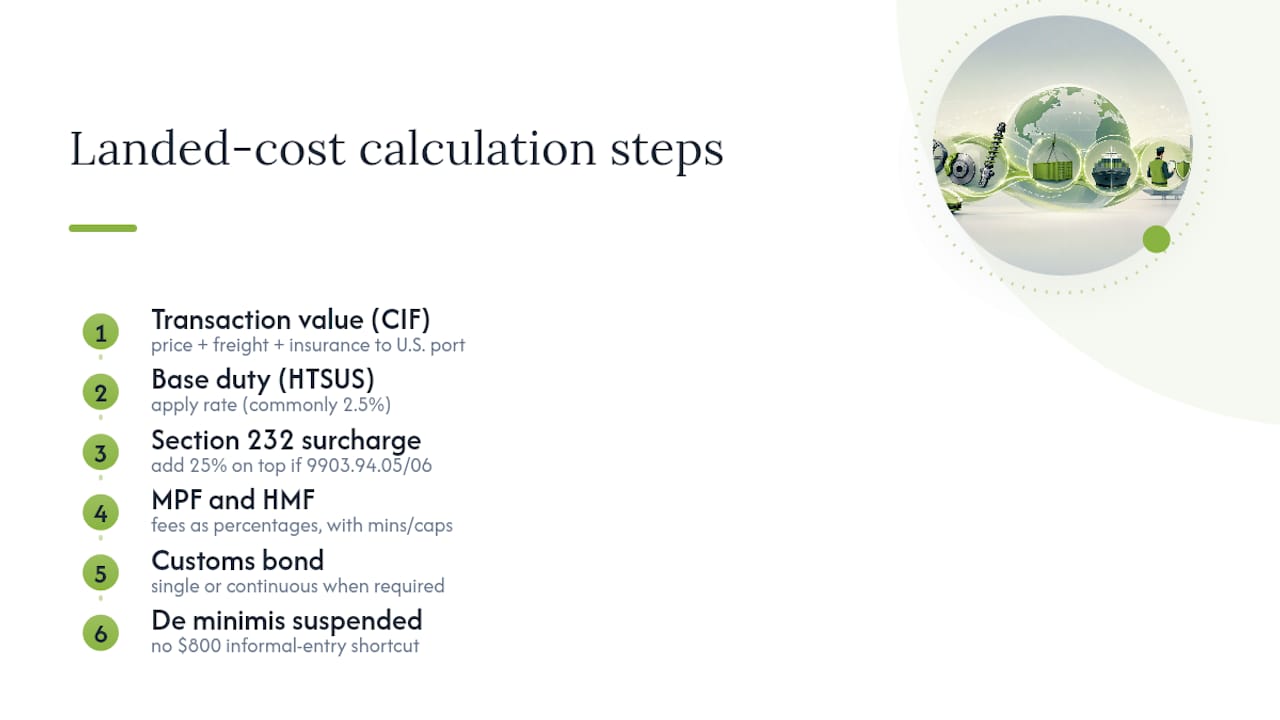
Start with the transaction value, generally the price paid plus freight and insurance to the U.S. port (the CIF value). Apply the base HTSUS duty rate, commonly the standard 2.5 percent for many auto parts under chapter 87. If the part falls under 9903.94.05 or 9903.94.06 without a qualifying exemption, add the 25 percent Section 232 surcharge on top of that base rate, not in place of it.
The math on a $4,000 engine: Base duty at 2.5% adds $100. The Section 232 surcharge at 25% adds another $1,000. That’s $1,100 in duties on a part that would have cost just $100 in duties before May 2025, according to industry analysis from LegalClarity.
Beyond duties, every commercial entry picks up the Merchandise Processing Fee (MPF) and, for ocean shipments, the Harbor Maintenance Fee (HMF). Both are calculated as a percentage of value with statutory minimums and caps, and neither one cares whether Section 232 applies. A customs bond, either a single-entry bond sized to the shipment or a continuous bond covering a year of activity, adds another cost line and is generally required once your import value crosses CBP’s bonding thresholds.
One change that’s tripped up smaller importers: de minimis treatment (the old $800 threshold for duty-free, informal entry) has been suspended for many shipment types. Parts that used to slide through without a formal entry now often require full documentation and duty payment, even at modest values. If your sourcing strategy leaned on splitting shipments to stay under that threshold, that workaround no longer holds up the way it used to.
HTS Classification Mistakes That Cost Importers Money
Getting the ten-digit HTS code right is the single biggest lever you control in this entire process. Most car parts fall somewhere under chapter 87, with heading 8708 covering a wide swath of vehicle parts and accessories, but the specific subheading determines both the base rate and whether Section 232 applies at all.
- Confirm the base chapter 87 classification first. The general description on a supplier invoice (“brake components,” “engine parts”) isn’t a classification. Match the actual part function against the HTS structure before you touch chapter 99.
- Check whether a chapter 99 heading applies on top. A correct chapter 87 code doesn’t tell you whether 9903.94.05 or 9903.94.06 also applies. Both classifications need to appear on the entry.
- Request a binding ruling for ambiguous items. Assemblies that combine parts from multiple HTS categories, aftermarket kits, and reprogrammed ECUs are common flashpoints. A CBP binding ruling locks in the classification and protects you if an audit challenges it later.
- Document your reasoning even without a ruling. Keep engineering specs, supplier data sheets, and prior CBP rulings on comparable goods on file. If CBP questions a classification, having a paper trail beats reconstructing your logic after the fact.
- Watch aftermarket replacements especially closely. A part functionally identical to an OEM component can sometimes classify differently depending on how it’s marketed or packaged, which changes duty exposure in ways that surprise a lot of importers.
Entry Filing Checklist for Importers and Customs Brokers
Clearing a shipment of covered auto parts through ACE requires more paperwork than a routine entry, and missing one field is a common source of rejections and delays.
Have these ready before the shipment lands:
- Commercial invoice with accurate part descriptions and unit values
- Packing list matching the invoice line by line
- Bill of lading or air waybill
- Customs bond (continuous or single-entry, depending on volume)
- Power of attorney if a licensed broker is filing on your behalf
- EPA and DOT forms where the part triggers emissions or safety declarations
The entry summary itself needs both the standard chapter 87 HTS code and the applicable chapter 99 heading (such as 9903.94.05 or 9903.94.06) reported together. If you’re claiming the Department of Commerce’s import adjustment offset, the offset license number goes in the Importer Additional Declaration Field, known as the 54 record, under Type Code 11, using the eight-character format DOC issues to approved manufacturers.
Entry rejections tied to Section 232 filings usually trace back to a missing chapter 99 heading, a mismatched offset license format, or a bond that doesn’t cover the declared value. CBP’s CSMS bulletins publish specific field-level guidance whenever the agency sees a pattern of filing errors, so checking recent messages before a large shipment is worth the ten minutes it takes.
Relief Options: USMCA Treatment, DOC Offsets, and Drawback Limits
A few mechanisms can reduce or eliminate the Section 232 hit, but each comes with real limits importers need to understand before they build a sourcing plan around them.
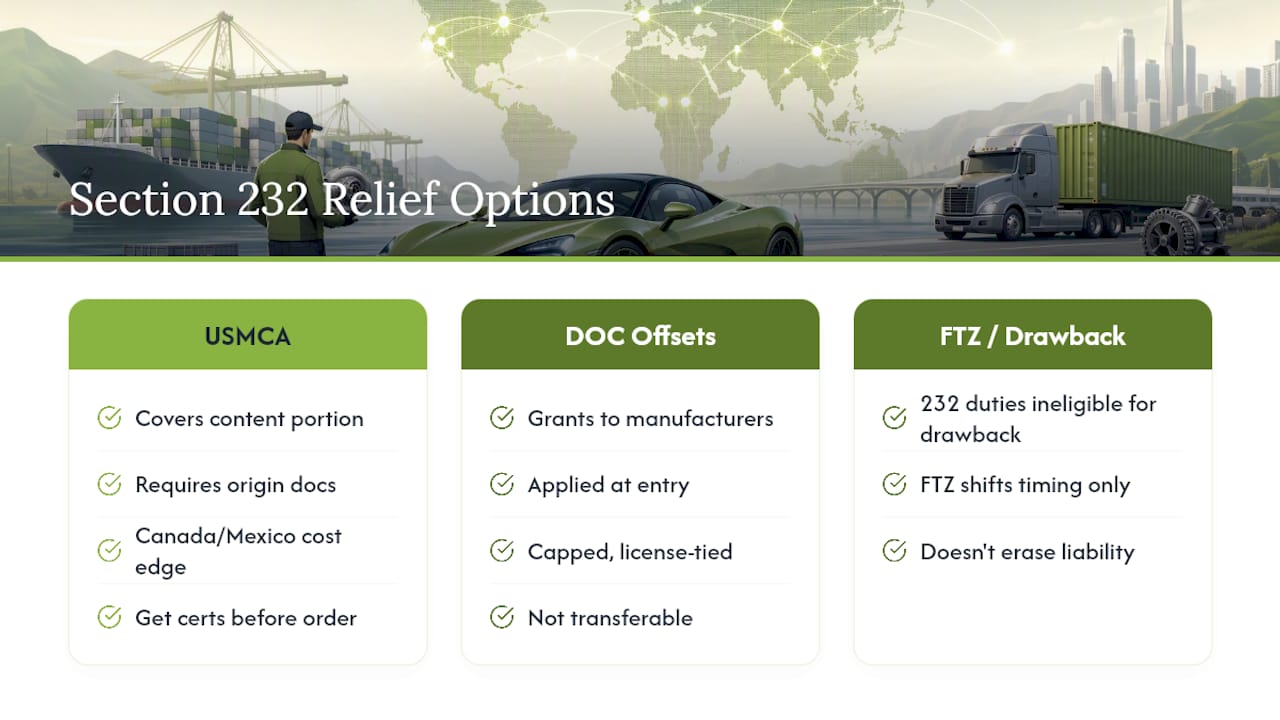
USMCA preferential treatment is the most direct path. It covers the content portion of a part’s value once DOC and CBP finalize that calculation method. That means suppliers in Canada and Mexico with solid origin documentation have a real cost advantage right now over otherwise-identical parts sourced from Asia or Europe.
The import adjustment offset works differently. DOC grants offset amounts directly to automobile manufacturers, not to parts importers generally, based on their U.S. production volume. An importer of record can apply an approved offset against Section 232 liability on entry, but the offset is capped, tied to a specific license number, and not transferable between companies. If you’re not the manufacturer who received the grant, you don’t get to use someone else’s offset.
Foreign trade zones and drawback carry a hard limit worth remembering: Section 232 duties are not eligible for duty drawback, according to LegalClarity’s analysis of the program. FTZ admission still affects when duty liability triggers, but it doesn’t erase it for covered parts.
Pro Tip: If you source from Canada or Mexico, ask suppliers for USMCA origin certificates before you place the order, not after the shipment arrives. Retroactive documentation requests slow everything down and sometimes fail entirely if the supplier didn’t track originating content from the start.
A Step-by-Step Way to Estimate Landed Cost Before You Buy
Pricing a shipment correctly means working through the same sequence every time, in this order, as outlined in the guidance on customs and import requirements for vehicles:
- Get the supplier’s cost in the currency of sale.
- Add freight and insurance to establish the CIF transaction value CBP will use for duty calculations.
- Apply the base HTS duty rate for the part’s chapter 87 classification.
- Add the 25 percent Section 232 surcharge if the part falls under 9903.94.05 or 9903.94.06 and doesn’t qualify for a USMCA exemption.
- Add MPF and HMF based on the transaction value.
- Add broker fees and bond costs allocated to the shipment.
That total is your real landed cost, and it’s often dramatically higher than a quote based on the base duty rate alone.
The gap is stark: a covered engine valued at $4,000 goes from roughly $100 in base duty to over $1,100 once the Section 232 surcharge, MPF, and HMF are all counted, based on the calculation shown earlier in this guide.
The most expensive mistakes are avoidable ones. Misclassification under the wrong HTS code is the top offender, followed closely by simply forgetting the chapter 99 surcharge applies when quoting a customer. A few importers have also tried claiming de minimis treatment on shipments that no longer qualify, which triggers penalties instead of savings. Working with a licensed customs broker, locking in HTS classification before the purchase order goes out, and checking CBP’s CSMS feed for updates before every large shipment closes most of that gap.
How Detailed Parts Data Reduces Classification Risk
Correct HTS classification depends on knowing exactly what a part is, not just what it’s called on an invoice. That’s where detailed parts records earn their keep. Listings link OEM part numbers and fitment data to a large catalog of entries, which gives importers and brokers a clearer starting point when they’re trying to distinguish, say, a genuine transmission assembly from a remanufactured unit that might classify differently.
An AI-driven parts search also helps surface the specific component behind a vague description, which matters when a supplier’s invoice says “drivetrain component” and you need the actual part identity to classify it correctly under chapter 87 and chapter 99. For sourcing decisions tied to USMCA eligibility, listings from North American sellers can help buyers identify parts more likely to carry qualifying origin documentation, which lowers Section 232 exposure when the paperwork supports it.
None of this replaces a customs broker’s judgment or a binding ruling on a genuinely ambiguous part. But better data going into the classification process means fewer surprises coming out of it.
Where This Policy Is Headed
Tariff policy on auto parts has moved fast since April 2025, and there’s no reason to expect it to sit still through the rest of 2026. New parts get added to the covered lists, offset procedures get refined, and USMCA transition rules will eventually settle into a permanent framework for tariffing non-U.S. content specifically rather than entire parts.
My priority for any importer right now is simple: lock in your HTS classification and origin documentation before you commit to a purchase order, not after. Bring in a customs broker early, especially for anything that might fall under 9903.94.05 or 9903.94.06. And when a new proclamation or CSMS message changes the math, re-price open quotes immediately rather than absorbing the difference. Supplier conversations about origin documentation are worth having now, before a shipment gets held up over paperwork nobody thought to request in advance.
— Artem
Primary Sources to Bookmark and Monitor
Check these directly before finalizing any classification or duty calculation:
- Federal Register: Proclamation 10908 for the original scope and effective dates
- CBP CSMS #64913145 for HTS headings and entry filing instructions
- CBP Section 232 FAQs for exemptions and application timing
- Federal Register amendments on offset procedures for DOC offset mechanics
Subscribe to CBP’s CSMS alerts and the Federal Register’s daily notifications for this topic. Given how often these lists change, checking manually every few weeks isn’t enough for anyone importing regularly.
Ready to source a hard-to-find part with fitment and origin data already attached to the listing? Supercars catalogs over 365,000 OEM and aftermarket components for exotic and luxury vehicles, with AI-powered search built to cut through the ambiguity that causes classification headaches in the first place.
Sources
- Adjusting Imports of Automobiles and Automobile Parts into the United States — Federal Register
- Section 232 additional FAQs - Automobiles and Auto Parts | U.S. Customs and Border Protection
- Amendments to Adjusting Imports of Automobiles and Automobile Parts Into the United States — Federal Register
- Importing Auto Parts into the US: Duties, Tariffs and Rules - LegalClarity
FAQ
How Much Is U.S. Import Duty on Cars and Car Parts?
It depends on the specific part and its HTS classification.
Can You Bring Car Parts Through Customs Without a Formal Entry?
Not reliably anymore. The suspension of de minimis treatment for many shipment types means parts that once cleared informally under an $800 value threshold now often require full entry documentation and duty payment.